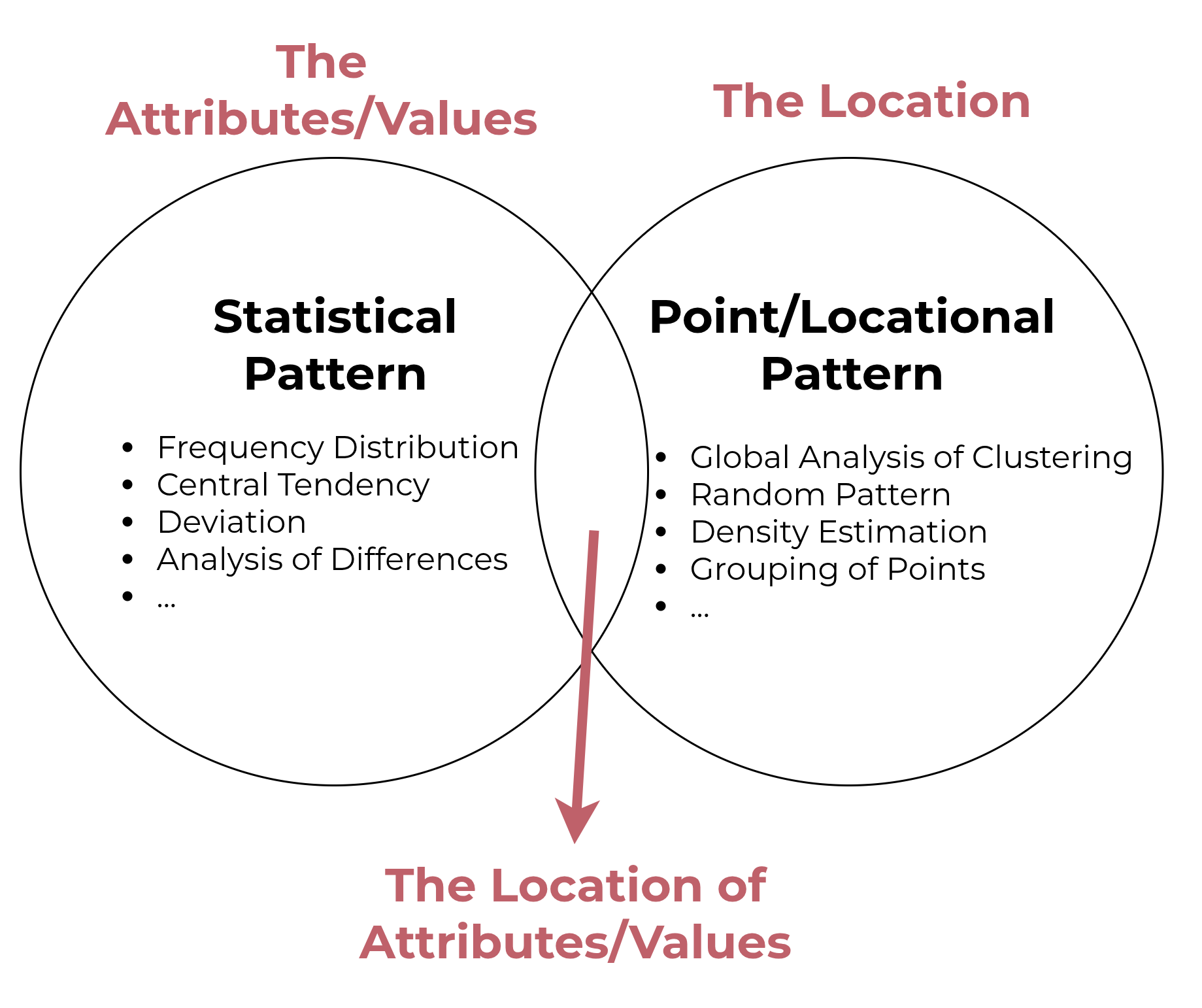
Getis-Ord General G
Three things to notice next
the difference between ‘stars’: with star means can equal to
The lower part (denominator) is a kind of standardizig process to control the range of the resulting values.
Global version
General G:
General G*:
Local version
Gi:
Gi*:
The three measures
Moran’s I
focus on (deviation from the mean value)
large positive value (I>0): spatial clusters (HH or LL)
large negative value (I<0): spatial outliers (HL or LH)
near zero (I=0): random
Geary’s C
focus on (squared differences)
small value (c<1): spatial clusters (HH or LL)
large value (c>1): spatial outliers (HL or LH)
near 1 (c=1): random
Getis-Ord G*
focus on (the intensity of values in local neighborhoods to the global average)
large value (G* > mean(G*)): hot-spot (HH)
small value (G* < mean(G*)): cold-spot (LL)
near mean(G*): random
Interpretation
Significance Maps
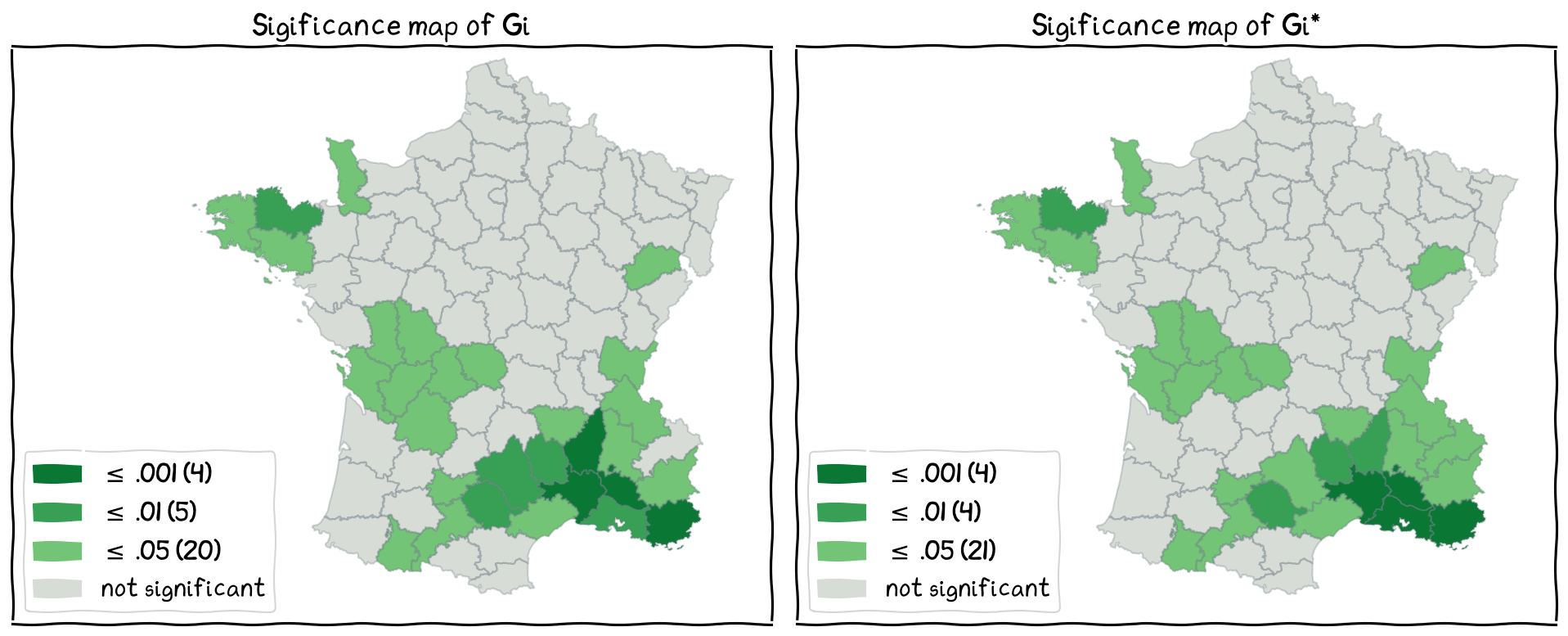
Significance Maps
Cluster Maps
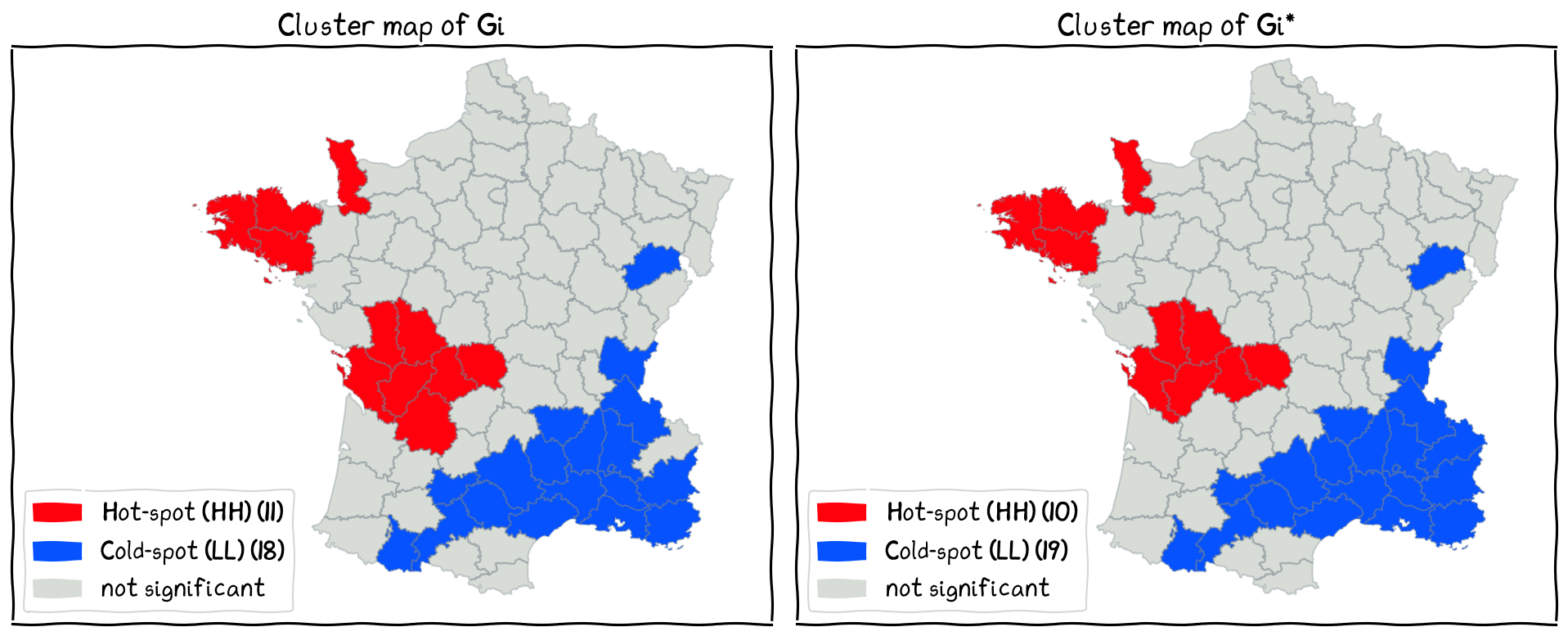
Cluster Maps
Closing Remarks
Choosing the appropriate method(s)
There are so many different methods and equations for spatial autocorrelation, which one should I use?
Aim of Visualisation
If you only want to detect high and low clustering phenomena, the Getis-Ord G statistics could be sufficient.
If your data are expected to have a common middle value (e.g., mean), and you aim to detect hot-spots and cold-spots in relation to this middle value, Moran’s I is ideal.
If you want to detect places with similar values (not necessarily compared to the middle value), Geary’s C is the way to go.
Scale Sensitivity
Moran’s I is more sensitive to larger-scale spatial patterns, as every value is compared to the global mean.
Geary’s C is better at detecting local, smaller-scale variations, since it calculates the differences rather than similarity between values.
Getis-Ord G statistic is also more sensitive to large-scale spatial patterns. The range of the product obtained by multiplying a pair of values implies that it focuses on global high and global low value pairs.
Comparison with Previous Studies
If you want to compare your results with other research in your field, choose a method that is commonly used in those studies for consistency and ease of comparison.
What we have learnt so far