After this page, you should be able to:
Retain child subtrees and repair all affected ancestors after deletion.
Check ordered keys, cached heights, balance and empty transitions.
Builds on: BST deletion and the shared rebalance helper.
Code languages: Python defines the explanations, figures and self-checks. Use the language guide for native conventions and dependencies. Complete runnable topic examples: Python · JavaScript · Julia.
The same BST readers and OrderedSet interface are reused from Topic 7. Julia updates use function calls, not dot methods. All variants use empty height −1, leaf height 0, and left height minus right height; rotations must return and reconnect the new subtree root.
Operation contract
avl_delete(root,key) returns the surviving subtree root, deleting a present key once and treating an absent key as a no-op. An empty tree returns None; deleting a singleton returns None as the new root. All remaining nodes must preserve strict key order, cached heights and AVL balance. Public strict removal, tolerant discard and returned-key extraction are supplied by the common adapter.
Remove as in a BST, then restore balance
First apply ordinary BST deletion: remove a leaf, retain the whole child subtree for a one-child node, or copy a successor key and delete its original node. Then update heights and rebalance each remaining ancestor on the return path.
This code uses the same rebalance helper as insertion. An absent key leaves the key set unchanged. Keys are distinct and no associated values are stored in this teaching model.
def avl_delete(node, key):
    if node is None:
        return None
    if key < node.key:
        node.left = avl_delete(node.left, key)
    elif key > node.key:
        node.right = avl_delete(node.right, key)
    else:
        if node.left is None:
            return node.right
        if node.right is None:
            return node.left
        successor = node.right
        while successor.left is not None:
            successor = successor.left
        node.key = successor.key
        node.right = avl_delete(node.right, successor.key)
    return rebalance(node)
function avl_delete(node, key) {
if (node === null) return null;
if (key < node.key) node.left = avl_delete(node.left, key);
else if (key > node.key) node.right = avl_delete(node.right, key);
else {
if (node.left === null) return node.right;
if (node.right === null) return node.left;
let successor = node.right;
while (successor.left !== null) successor = successor.left;
node.key = successor.key; node.right = avl_delete(node.right, successor.key);
}
return rebalance(node);
}function avl_delete(node, key)
node === nothing && return nothing
if key < node.key; node.left = avl_delete(node.left, key)
elseif key > node.key; node.right = avl_delete(node.right, key)
else
node.left === nothing && return node.right
node.right === nothing && return node.left
successor = node.right
while successor.left !== nothing; successor = successor.left; end
node.key = successor.key; node.right = avl_delete(node.right, successor.key)
end
return rebalance(node)
endCall it as root = avl_delete(root, key). When a removed node returns its only child, that child’s unchanged subtree already has valid heights. Its parent receives the result and performs the next balance check. A singleton deletion returns None directly.
A zero-factor heavy child needs a single rotation
Start with root 4, left child 2 (with children 1 and 3), and right child 5. Deleting 5 makes 4 left-heavy by two; child 2 has factor zero. A single right rotation gives root 2, left child 1 and right child 4, whose left child is 3.
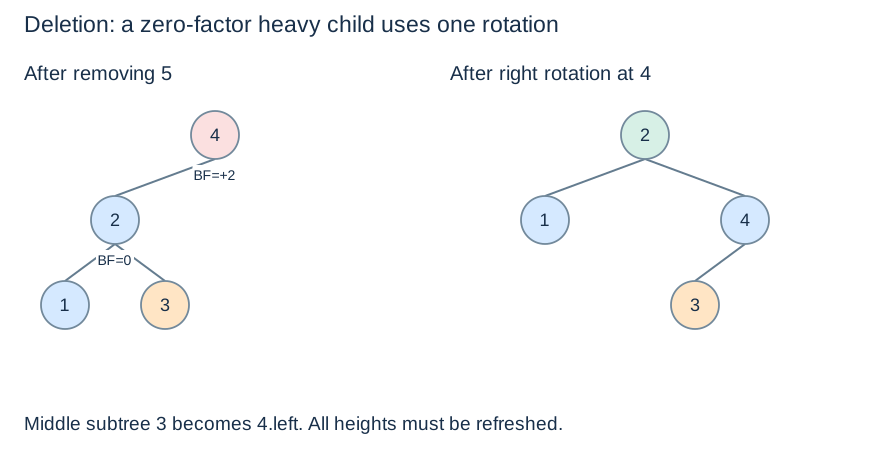
The example tests two details at once: the factor-zero case must not trigger an unnecessary double rotation, and the nonempty middle subtree 3 must survive. A deletion implementation that handles only the four three-key insertion examples can miss this case.
Continue because subtree height can shrink
After deletion and a local repair, a subtree can be shorter than it was before deletion. Its parent can therefore become unbalanced, and repair may be needed at several ancestors. The function above continues all the way upward, computing each decision from current child heights rather than from the deleted key’s former position.
There are ancestors. Each performs constant local work and at most two rotations, so deletion remains time and stack space. Unlike insertion, the number of local repairs can grow with tree height.
Check all three maintained properties
A convincing check verifies the key set and strict ancestor bounds, recomputes actual heights from the links, and confirms both cached heights and balance factors at every node. Sorted inorder output alone cannot detect a stale height or an unbalanced but ordered tree.
Useful transitions include deleting the root, deleting an absent key, removing a successor with a right child, repeated deletion until empty, and inserting again afterwards. These are structural checks, not just examples of ordinary lookup.
Implementation choices and suitability
Successor copying preserves the target node object while changing its key; the same node-identity caveat as ordinary BST deletion applies. Current child factors, not the deleted key, choose the repair. Recursive returns retain the path without parent pointers, using O(log(n+2)) stack space. No new tree nodes are allocated during removal; local repairs use constant additional workspace.
Check your understanding
Predict the returned result, links or invariant before opening the explanation.
1. In root 4 with left child 2 (children 1,3) and right child 5, what follows deleting 5?
Show explanation
A single right rotation promotes 2; 3 transfers to 4.left. The zero-factor child case must retain the middle subtree.
2. After deleting the last key, what root should be retained?
Show explanation
None. The returned empty root is the correct result; an owning adapter also changes its count to zero.
Further reading: Cornell’s AVL notes. Return to the topic overview or compare the different split rules in k-d trees.