After this page, you should be able to:
Trace bottom-up construction with valid child-subtree preconditions.
Explain linear building work and distinguish copied output from in-place heapify.
Builds on: Sift-down repairs a root whose child subtrees are already heaps.
Code languages: Python defines the explanations, figures and self-checks. Use the language guide for native conventions and dependencies. Complete runnable topic examples: Python · JavaScript · Julia.
The Julia heap array starts at 1: parent=floor(i/2), children=2i and 2i+1. The support MinHeap implements heap repair rather than sorting on each removal. Stable record heaps compare priority and a unique counter before the payload; max queues negate numeric priorities.
Construction contract and implementation choice
build_min_heap(values) returns a new list holding exactly the supplied priorities with their multiplicities, arranged as a min-heap. It does not sort them or mutate an input list. The copy is shallow. Finite numeric priorities satisfy this topic’s comparison contract; empty input returns a new empty list. For a general iterable, iteration consumes it to produce the copy.
The public record queues start empty; this numeric builder is not a bulk-construction method on those classes. For a record batch, constructing (priority,sequence,item) entries then using heapify would also need an explicit arrival-order policy.
Begin where every child is already a heap
Given an unordered collection, repeated insertion is valid, but a bottom-up builder can do less work. Every leaf is already a one-item heap. Visit internal nodes from the last one back to the root, applying sift-down at each position.
def build_min_heap(values):
    heap = list(values)
    for i in range(len(heap) // 2 - 1, -1, -1):
        sift_down(heap, i)
    return heap
function build_min_heap(values) {
const heap = [...values];
for (let i = Math.floor(heap.length / 2) - 1; i >= 0; i--) sift_down(heap, i);
return heap;
}function build_min_heap(values)
heap = collect(values)
for i in div(length(heap), 2):-1:1
sift_down!(heap, i)
end
return heap
endThis function reuses sift_down from the preceding page. It copies the input once, then modifies and returns that new list. Empty and singleton inputs need no repair iterations. An in-place version would omit the initial copy and operate on a supplied list.
Children are repaired before their parent
Before processing index i, all subtrees rooted at larger indices are valid heaps. Its child indices are larger, so sift-down’s precondition holds. Repairing i preserves the already valid descendant structure. When index 0 is repaired, the entire array is a heap.
Notice the direction: a top-down scan of arbitrary input does not establish this precondition. Moving a small root into place before its descendants are repaired can leave a violation behind.
Build from 9, 5, 6, 2, 3, 4
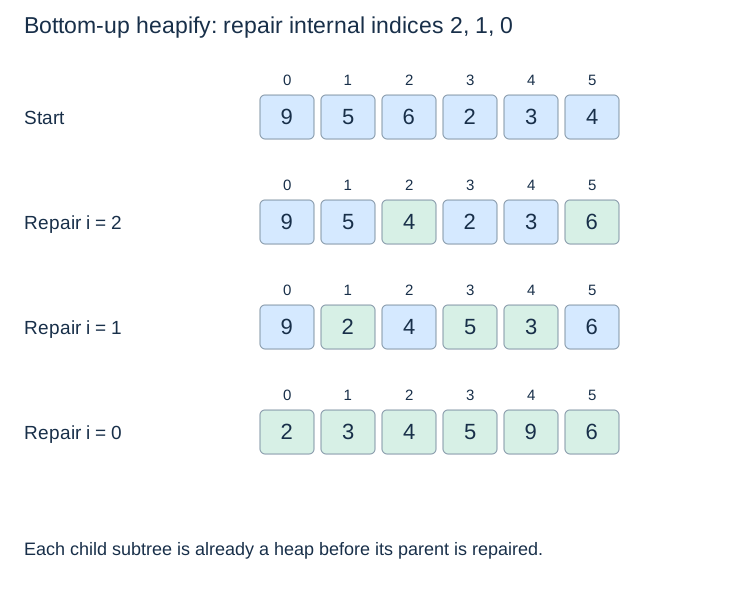
| Internal index | Array after sift-down |
|---|---|
| 2 | [9, 5, 4, 2, 3, 6] |
| 1 | [9, 2, 4, 5, 3, 6] |
| 0 | [2, 3, 4, 5, 9, 6] |
The final result satisfies every parent–child comparison, although the array is not sorted. Heap construction establishes enough order to select minima efficiently; it does not solve the full sorting problem.
Most nodes cannot move far
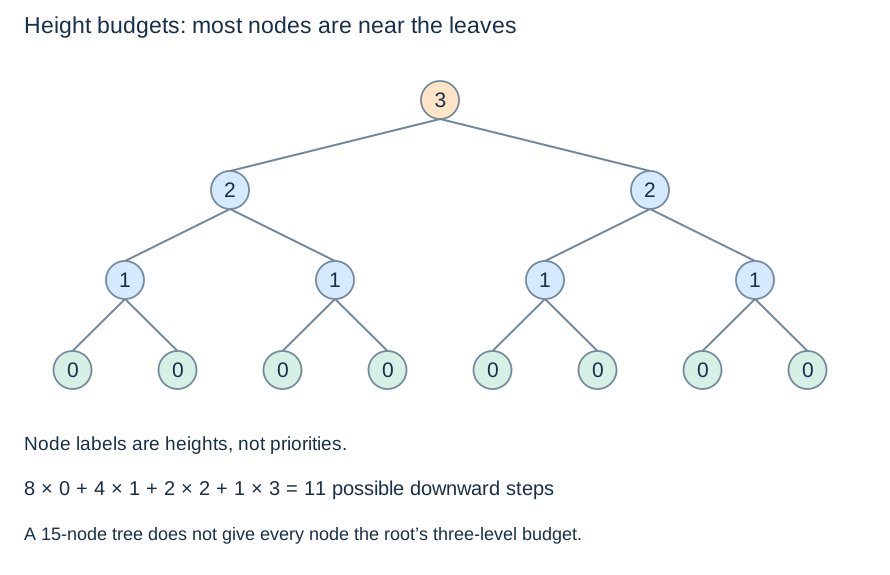
Multiplying n nodes by the maximum height gives a valid but loose upper bound. Most nodes are near the leaves and have a much smaller downward budget.
One way to count tightly is to group possible downward steps by distance j from a node. A complete n-node tree has at most nodes with height at least j. Each can contribute at most one j-th downward step. Thus the total downward-step budget is bounded by
Each step makes only constant comparison work, and each internal node adds constant loop overhead. This gives repair work; copying the n input items also takes time, so the shown builder is overall.
Repeated insertion has an bound and can take comparisons for descending distinct priorities. Bottom-up construction is preferable when the whole batch is already available. The builder uses additional list storage; iterative in-place heapify uses auxiliary storage beyond its existing array.
Space, choices and suitability
The returned list occupies O(n) result storage and retains the payload references; the iterative repairs use O(1) workspace beyond it. The source and copied result coexist for a list input. An in-place heapify has a different mutation contract and omits that growing output allocation. Appending one at a time is useful for interleaved arrivals; bottom-up construction avoids repeated long upward repairs when the entire batch is available.
Check your understanding
Predict the returned result and remaining heap before opening the explanation.
1. Which internal indices are processed for six items?
Show explanation
2,1,0. Their children are already valid heaps when each parent is repaired.
2. Does build_min_heap change the supplied input list?
Show explanation
No. It copies it and returns a new heap list. In-place heapify would have a different mutation contract.