After this page, you should be able to:
Compare indexed merging, front removal, slicing and reusable-buffer choices.
Explain how contracts, mutation and allocation change complete-operation costs.
Builds on: Merge contracts and code, recursion costs and list-reference storage.
“Take the smallest first unused item” is a sound merge strategy. How we implement “take” determines whether the code retains the intended cost.
Removing the front of a list shifts references
Python lists support indexed access, but removing index zero requires moving the following references to close the gap. For a list currently holding m items, pop(0) shifts m − 1 remaining references and takes linear time in m.
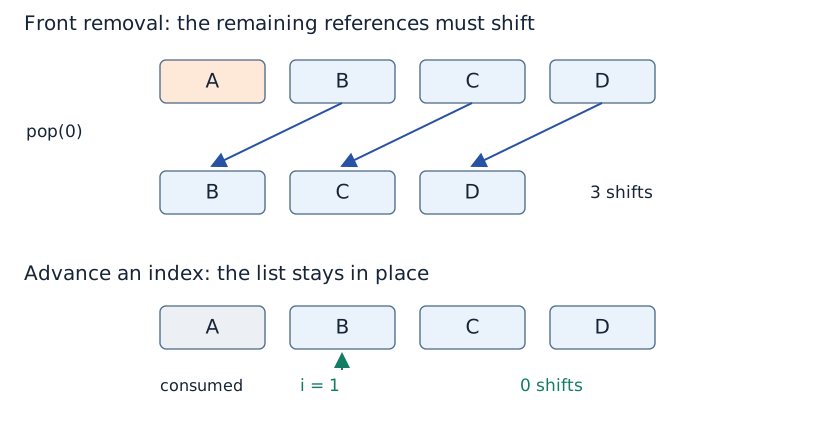
The shifting concerns entries in the list’s storage; it does not move or deeply copy the payload objects themselves. Repeatedly shortening one side from m to zero can cause
reference shifts. For example, when every item in a left half precedes every item in a right half, front-removal merging empties that left half one item at a time. With halves of comparable length, this already produces quadratic shifting in the total merge size.
Advancing an index preserves linear merging
The complete merge code keeps indices i and j. Reading left[i] is constant time under our model; incrementing i changes which item is considered next without closing any gap in the input.
For input lengths a and b, at most a + b − 1 candidate comparisons are needed when both inputs are nonempty. Every input item is appended or extended into the result once. Total merge time is Θ(a + b) for nonempty total input, including copying the remainder.
The indices are positions, not raw machine pointers. This distinction also explains why the implementation leaves its input lists unchanged, whereas a version using pop(0) mutates them. Equal final sorted values do not make the side effects identical.
Slices allocate new outer lists
The sort creates values[:middle] and values[middle:]. A list slice of k items allocates a new list and copies k references: Θ(k) time and space. Those referenced objects are still shared unless another operation copies them.
Both slices at one call copy n references in total. Across one full balanced level, the copied sizes also sum to n. This is why slicing adds work but still fits the Θ(n log n) time analysis.
Similarly, the merge code’s left[i:] and right[j:] produce temporary remainder slices. They can be replaced with loops that append remaining elements by index, avoiding those particular temporary lists. Both versions still have linear merge time and allocate a result list.
Keep strategy, representation and cost connected
| Design decision | Consequence |
|---|---|
| Split near the midpoint | Logarithmic recursion depth |
| Solve both halves | Branching tree of calls; depth alone does not count all work |
| Merge with indices | Linear combining work under the stated model |
Merge with repeated pop(0) | Repeated shifts can make combining quadratic |
| Pass list slices | Copies references into new outer lists |
| Retain left result while sorting right | Contributes to peak storage, even when its call has returned |
An alternative implementation can sort ranges within one array and reuse an auxiliary buffer. Its indices, side effects and storage accounting must be specified. We do not assume that every program called “merge sort” has identical costs or memory behaviour.
Questions to revisit
Where is the reachable base case? What measure decreases? Which operations happen before and after child calls? How many calls are active simultaneously? What does the combine operation cost in the chosen representation?
Use those questions when reading Sorting, search-tree and graph traversal topics.
Compare equivalent goals without hiding side effects
| Choice | Work and mutation | Storage implications |
|---|---|---|
| Shown merge with indices and remainder slices | Θ(a+b+1); input lists unchanged | New result plus possible linear temporary remainder storage |
| Indices with explicit remainder loops | Same linear work and preserved inputs | New result; constant local merge workspace excluding it |
| Repeated front removal from list halves | Can require quadratic shifts in total merge size; consumes those halves | New result does not make input mutation disappear |
| Recursive midpoint slices | Θ(n log(n+1)+1) whole-sort work with the shown combine | Linear peak additional space including result; logarithmic stack |
| Range indices plus a reusable merge buffer | Can retain linear combine work; side effects depend on the chosen interface | Linear buffer, with allocation reusable across merge levels |
| Bottom-up merge passes | Can retain Θ(n log(n+1)+1) sorting work without recursive sort calls | Usually a merge buffer; eliminating recursion does not make it in-place |
Only the indexed slicing-based implementation has full code on the preceding page; the alternatives here are design comparisons, not extra functions provided by this page. A front-removal version that first copies its halves still pays for those copies and shifts, even if it protects the caller’s original list.
For a balanced sort whose merge repeatedly shifts a linear-sized half, local worst-case merging is Θ(n²), giving T(n)=2T(n/2)+Θ(n²) on power-of-two inputs. Summing its geometric level costs yields Θ(n²) worst-case time, rather than preserving the indexed version’s Θ(n log n) bound. This is a conditional analysis of that alternative, not a claim about the unchanged merge_sorted implementation.
Inspect the actual list operations before transferring a complexity claim. Avoided copies, input mutation, reusable storage, stable ties and recursion overhead are separate choices; improving one does not settle the others.
Check your understanding
Trace the calls or predict the result before opening the explanation.
1. If a left list has four items and is emptied by repeated pop(0), how many reference shifts occur?
Show explanation
3+2+1+0=6 shifts. This is separate from comparisons and writes into the output list.
2. Replacing remainder slices with append loops makes the merge output disappear. True or false?
Show explanation
False. It avoids those temporary remainder lists, but still returns a newly allocated result containing a+b references.
Next: Sorting, which compares this merge strategy with insertion, adjacent swaps and partitioning.
Browse: Recursion · Concept index