After this page, you should be able to:
Connect natural runs, insertion sorting and stable merging in a hybrid algorithm.
Explain merge-order costs and distinguish mutation from constant-space sorting.
Builds on: Insertion sort, merge sort and stability. This is a conceptual overview, not a complete Timsort implementation.
Code languages: Python defines the explanations, figures and self-checks. Use the language guide for native conventions and dependencies. Complete runnable topic examples: Python · JavaScript · Julia.
Teaching sorts retain their mutation/return policy: JavaScript mutators return undefined and Julia teaching mutators return nothing. Built-in sort APIs are shown separately: JavaScript sort and Julia sort! return their mutated arrays. The Timsort/Powersort discussion describes Python’s implementation, not the algorithms used by the other runtimes.
Idea and visual trace
A run is a contiguous stretch already in order. A natural merge sort discovers runs rather than always splitting at the midpoint. Timsort combines run detection, short-run insertion sorting and stable merging.
Consider [1,4,7,2,3,8]: two ascending runs, [1,4,7] and [2,3,8], can be merged into [1,2,3,4,7,8]. Existing order becomes useful work already done.
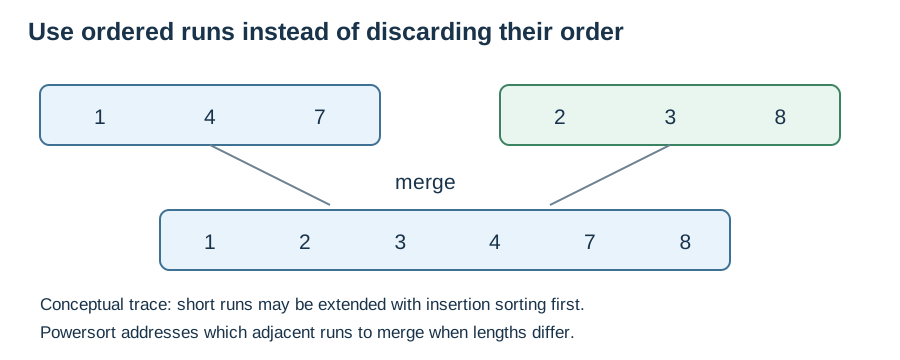
This tiny example isolates the run/merge idea. A production implementation may extend a short run using insertion sort rather than execute these exact two merge steps.
Python interface
records = [("A", 4), ("B", 1), ("C", 4)]
ordered = sorted(records, key=lambda record: record[1])
assert ordered == [("B", 1), ("A", 4), ("C", 4)]
assert records == [("A", 4), ("B", 1), ("C", 4)]
result = records.sort(key=lambda record: record[1], reverse=True)
assert result is None
assert records == [("A", 4), ("C", 4), ("B", 1)]
// Native sort API comparison; this does not claim its engine uses Powersort.
let records = [["A", 4], ["B", 1], ["C", 4]];
let ordered = records.slice().sort((a, b) => a[1] - b[1]);
console.assert(JSON.stringify(ordered) === JSON.stringify([["B", 1], ["A", 4], ["C", 4]]));
let result = records.sort((a, b) => b[1] - a[1]);
console.assert(result === records);
console.assert(JSON.stringify(records) === JSON.stringify([["A", 4], ["C", 4], ["B", 1]]));# Native API comparison, explicitly choosing stable merging, not Powersort.
records = [("A", 4), ("B", 1), ("C", 4)]
ordered = sort(records; by=r -> r[2], alg=MergeSort)
@assert ordered == [("B", 1), ("A", 4), ("C", 4)]
@assert records == [("A", 4), ("B", 1), ("C", 4)]
result = sort!(records; by=r -> r[2], rev=true, alg=MergeSort)
@assert result === records
@assert records == [("A", 4), ("C", 4), ("B", 1)]Both interfaces preserve equal-key order, including with reverse=True. These are calls to Python’s implementation, not a hand-written Timsort listing.
Why it works
Identify or construct sorted runs, then merge adjacent runs without dropping records. A stable merge preserves tie order. Repeat until one run covers the list. The difficult engineering question is which merges to perform when run lengths differ.
Implementation choices
Short runs can be extended with stable binary insertion sorting; binary search reduces comparisons, but shifting records still costs work. Descending-run normalisation must preserve equal-key order: blindly reversing [4_A,4_B,2] would put B before A.
CPython’s Timsort-derived natural merge sort uses a Powersort merge policy in the Python 3.14 design notes. We retain “Timsort” for this introductory family overview; its original merge scheduling rules should not be presented as current CPython internals. Thresholds and optimisations such as galloping are beyond this page.
Powersort: choose the merge order
Merging runs of lengths a and b performs work proportional to a+b in the simple full-merge model. With adjacent run lengths 100,10,10, merging left-to-right costs 110+120=230 units. Merging the two short runs first costs 20+120=140. The output is the same, but the long run participates in less repeated work. These are illustrative run lengths, not a claim about how a particular tiny list is processed.
Powersort uses run positions and lengths to assign boundary “powers” and schedule adjacent merges into a nearly optimal merge tree. It is not simply “always merge the two shortest runs”: adjacency and original order matter. In CPython it supplies the merge policy inside the natural-run sorting implementation; it is not another Python sorting function. The detailed power calculation is an optional advanced topic.
This example compares abstract full-merge work, not exact comparisons, wall-clock timings or CPython’s optimised merge counts. See Munro and Wild’s original Powersort paper.
Stability and in-place behaviour
The built-in sort is stable. list.sort() changes the existing list, but merging may require O(n) temporary storage. Thus “in place” in the interface documentation describes mutation; it does not imply O(1) auxiliary space. sorted() additionally constructs a new output list.
Time and space costs
With constant-cost comparisons, best time is Θ(n) when existing order permits a scan with little further work; worst time is O(n log n). Randomly ordered data typically requires Θ(n log n) work. Worst-case additional storage is O(n). Expensive key functions and comparisons add their own costs; Python evaluates a supplied key once per record.
When to use it
For ordinary Python applications, start with sorted() or .sort(). This hybrid explains why useful order in real data matters alongside worst-case bounds.
References: Python sorting guide for interface guarantees; CPython 3.14 sorting design notes for run handling, temporary storage and merge-policy details.
Check your understanding
1. For adjacent run lengths 100,10,10, how much abstract full-merge work is saved by merging the two short runs first?
Show explanation
Left-to-right costs 110+120=230 units; the short pair first costs 20+120=140. The saving is 90 units. This models merge lengths, not exact comparisons or a measured runtime.
2. Does records.sort() returning None prove constant auxiliary space?
Show explanation
No. The return convention describes the interface. Internal merge buffers can still grow with the list.
Next: Compare the strategies.