After this page, you should be able to:
Use union returns for incremental connectivity and an unweighted forest.
Identify unsupported route, directed-reachability and deletion queries.
Builds on: The complete disjoint-set class and graph components.
Code languages: Python defines the explanations, figures and self-checks. Use the language guide for native conventions and dependencies. Complete runnable topic examples: Python · JavaScript · Julia.
JavaScript member indices are 0..n−1; Julia members are 1..n. Element count, component count and component size remain distinct. Julia find_set! and union_sets! may mutate representation links, preserving the same abstract partition and union-by-size tie rule.
Merge when an undirected connection arrives
Begin with every graph vertex in a singleton set. For each undirected edge a–b, union their components. Afterwards connected(a,b) answers whether the processed edges supply some path between them, even if no edge directly joins a and b.
The component count decreases exactly on successful unions. For n vertices, after k successful merges it is n−k. Isolated vertices remain singleton components until an incident connection is processed.
Reject a connection within one existing component
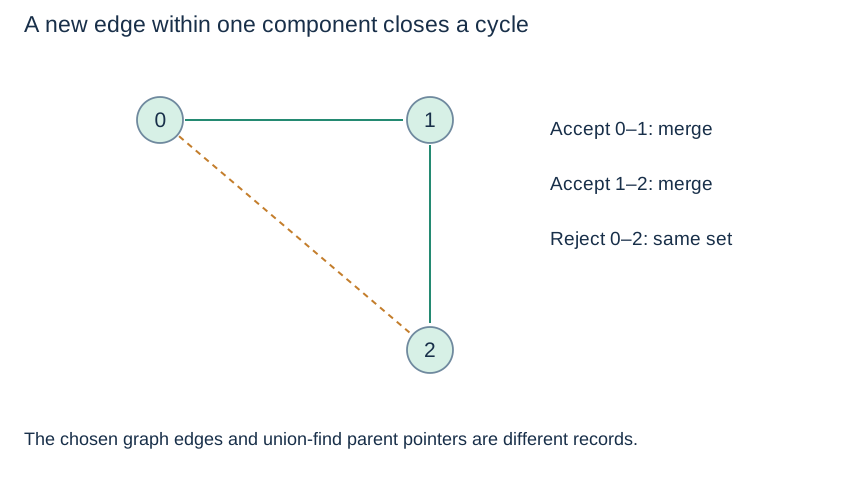
If a and b are already connected by previously accepted forest edges, adding a new edge between them closes a cycle. union(a,b) returns False, letting a forest builder reject that redundant connection. A repeated copy of an already processed edge is also redundant; whether parallel edges count as separate graph edges depends on the graph model.
def connection_forest(n, edges):
    sets = DisjointSet(n)
    chosen, rejected = [], []
    for a, b in edges:
        if sets.union(a, b):
            chosen.append((a, b))
        else:
            rejected.append((a, b))
    return chosen, rejected, sets.components
function connection_forest(n, edges) {
const sets = new DisjointSet(n), chosen = [], rejected = [];
for (const [a, b] of edges) (sets.union(a, b) ? chosen : rejected).push([a, b]);
return [chosen, rejected, sets.components];
}function connection_forest(n, edges)
sets = DisjointSet(n); chosen = Any[]; rejected = Any[]
for (a, b) in edges
push!(union_sets!(sets, a, b) ? chosen : rejected, (a, b))
end
return (chosen, rejected, sets.components)
endThis uses the class from the preceding page. It builds an undirected spanning forest of the processed connections, but does not minimise any weight. Kruskal adds the crucial increasing-weight scan.
Directed reachability is not an equivalence relation
For A→B and C→B, merging endpoints puts all three vertices together, but there is no directed path from A to C. Plain union–find therefore does not answer directed reachability, find strongly connected components, or detect directed cycles by ignoring arrow directions.
It can represent weak connectivity if the intended operation deliberately ignores direction. That is a different question and should be named explicitly.
Merging does not support splitting
Ordinary union–find cannot undo a component merge after an arbitrary graph edge is removed. Removing an edge may or may not disconnect a graph, and the compressed parent forest does not retain enough original connection information to decide that.
For occasional deletions, rebuilding connectivity from the remaining graph can be appropriate. Rollback or dynamic-connectivity methods are separate extensions with different rules; simply setting one parent back to itself is not a valid general deletion algorithm.
Choose between traversal and maintained partitions
Use BFS/DFS when you need actual routes, traversal order, or static component membership. Use union–find for repeated merge/connectivity operations and undirected cycle checks. To enumerate current members of every union–find component, scan all elements, call find on each, and group by the returned root; membership lists are not provided automatically by the parent arrays.
Function contract, implementation choices and costs
connection_forest(n, edges) requires valid integer endpoints in 0..n-1, constructs a fresh DisjointSet, and consumes endpoint pairs from edges. Run the class definition first. It returns (chosen, rejected, component_count) and does not mutate an input list of edges. An iterable is consumed. Duplicate edges are separate processed records: the first may merge groups, while later repeats are rejected. A self-loop is rejected because its two endpoints already have the same representative.
For q edge records and n≥2, time is O(n+qα(n)) including initialisation. Working arrays occupy O(n+1); chosen and rejected output lists together occupy O(q+1), so total additional storage is O(n+q+1). The output can be much larger than the chosen forest alone. Empty inputs yield ([], [], n); invalid endpoints raise IndexError through the class.
For a static graph, full BFS/DFS computes components in O(n+m+1) expected time and can record actual routes. Union–find is suited to interleaved additions and connectivity queries. Grouping all current members by find(x) requires n finds: O(nα(n)) amortised time for n≥2, plus Θ(n+1) output references and expected dictionary grouping costs. It is a separate operation, not an O(1) result supplied by the parent array.
Check your understanding
Predict the result or state change before opening the explanation.
1. Process (0,1), (1,2), (0,2) with n=3. Which record is rejected, and how many components remain?
Show explanation
(0,2) is rejected because its endpoints are already connected; one component remains. The first two records form an unweighted spanning tree.
2. Does sorting those records by weight change union–find itself?
Show explanation
No. Kruskal adds a weight-ordered edge policy around the same connectivity interface. An unsorted connection forest is not guaranteed minimum-weight.
Continue to graph ordering, paths and spanning trees. Its Kruskal reading reuses this disjoint-set class. You can also return to the topic overview or consult the coverage review.