After this page, you should be able to:
Specify the fixed-universe disjoint-set interface and union return semantics.
Distinguish representatives, element count, component count and component size.
Builds on: ADT contracts and undirected components.
Every object belongs to exactly one group
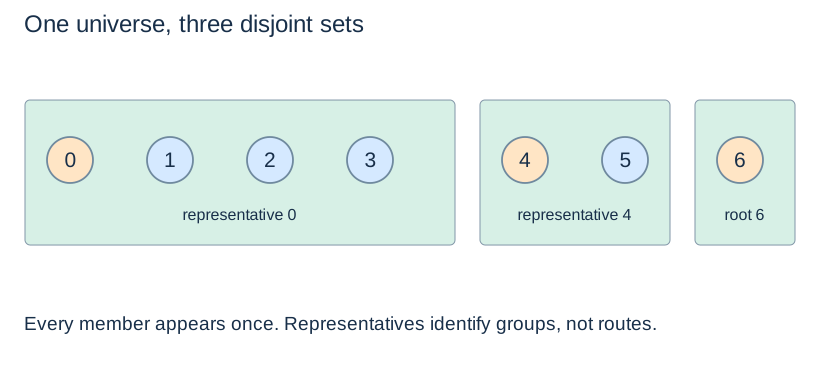
A partition divides a universe into nonempty, pairwise disjoint sets whose union is the whole universe. The sets {0,1,2,3}, {4,5} and {6} partition indices 0 through 6. No member can appear in two sets, and no member is omitted. The empty universe has an empty partition.
Specify the three central operations
| Operation | Meaning in this book |
|---|---|
find(x) | Return a representative of x’s current set |
connected(a, b) | Report whether a and b belong to the same set |
union(a, b) | Merge their sets; return True only if two different sets merged |
Initially every member is in its own singleton set. A successful union decreases the number of sets by one. Union within an existing set returns False and leaves the partition unchanged. It does not create a duplicate member or another copy of the group.
Complete the fixed-universe contract
Construction DisjointSet(n) creates n singleton groups for integer members 0..n-1. It does not insert graph edges or discover a graph’s components automatically. Duplicate unions do not create elements. The class is defined on the implementation page.
| Public query | Result; logical effect |
|---|---|
len(ds) | Number of elements, fixed at construction |
is_empty() | Whether there are zero elements; one merged group is not empty |
component_count() | Number of current groups; decreases only on a successful union |
component_size(x) | Number of elements in x’s group |
find(x) | Current representative; may compress parent links |
connected(a, b) | Boolean connectivity; may compress parent links |
union(a, b) | True if two groups merged, otherwise False; may also compress links |
DisjointSet(0) is valid. The constructor rejects non-integer, boolean and negative n with ValueError. Member operations reject non-integer, boolean, negative and out-of-range indices with IndexError. No public insertion or removal operation is supplied. The internal size list stores root metadata; it is not a public size() query. The retained components field is the count read by existing Kruskal examples; use component_count() when writing new client code.
A representative identifies a current set
The representative is an implementation-selected member identifying a set. It need not be the smallest member, earliest arrival, most important vertex or geometric centre. A later union can change a member’s representative by attaching its former root below another root.
Compare find(a) == find(b) when you need current connectivity. Do not assume that a saved representative remains the root forever. If an application needs a persistent label or a minimum member, maintain that information explicitly as component metadata.
A partition structure is not a general set container
A Python set supports membership and set operations on its stored elements. Union–find specialises in identifying and merging groups of elements efficiently. Its parent array does not directly list every member of a component or recover a route between two graph vertices.
Static undirected components can be computed once with BFS or DFS in time. Union–find is useful when merges and connectivity queries are interleaved. These structures answer related but different operational requirements.
Costs belong to the chosen representation
The abstract partition contract does not prescribe parent arrays or path compression. A direct group-label array makes connectivity easy but may scan all n elements on a merge. A parent forest links roots and shifts work to finding representatives. The implementation comparison separates plain forests, union by size, and compression.
For the supplied class, construction uses Θ(n+1) time/storage, count/empty queries use O(1), and operations that find roots have O(α(n)) amortised time for growing n with union by size and compression. A single call can still traverse O(log(n+1)) links. Component enumeration is a separate scan, not a constant-time find result.
Check your understanding
Predict the result or state change before opening the explanation.
1. Starting with seven singleton elements, three unions successfully merge different groups. What are len(ds) and component_count()?
Show explanation
Seven elements and four components. Union changes the partition, not the universe.
2. If union(a, b) returns False, has the abstract partition changed?
Show explanation
No. They were already connected. Its find calls may still shorten internal parent paths without changing connectivity.
Next: Parent forests.