After this page, you should be able to:
Specify selection, results and state changes independently of representation.
Distinguish an observer, a mutator and a rejected request.
Builds on: Topic 1’s ADT introduction supplies the first stack example.
Here we make operation contracts precise and connect them to the implementations in this topic.
Specify operations and behaviour
An abstract data type (ADT) describes the values being managed, the operations available, and the rules those operations must follow. It leaves the internal representation unspecified. The word abstract means we can reason about what an operation does without first knowing how the computer performs it.
Two objects that both provide add(x) and remove() need not implement the same ADT. One might remove the oldest item, while another removes the newest. Names alone do not establish behaviour.
An interface is a behavioural contract
Consider a queue for print jobs. A suitable contract says:
| Operation | Result and state change |
|---|---|
enqueue(job) | Add the job after all waiting jobs |
dequeue() | Remove and return the earliest waiting job |
front() | Return the earliest waiting job without removing it |
size() / len(q) | Return the number of waiting jobs without changing state |
is_empty() | Report whether any jobs remain |
The contract must also explain exceptional cases. In the implementations here, removal or inspection of an empty collection raises IndexError. A fixed-capacity queue also raises OverflowError if an enqueue finds it full. Other designs can choose other policies, but clients must know which policy applies.
Add, inspect, remove and extract
An insertion adds a record; an inspection observes one without changing the collection. A removal must specify which record disappears and whether it is returned. “Extract” commonly means remove and return; stack pop and queue dequeue already express that behaviour, so we do not add duplicate extract methods.
| ADT | Add | Inspect | Remove and return |
|---|---|---|---|
| Sequence | insert(i,x), append(x) | get(i) | remove_at(i) |
| Stack | push(x) | peek() | pop() |
| Queue | enqueue(x) | front() | dequeue() |
| Deque | add_first(x), add_last(x) | peek_first(), peek_last() | remove_first(), remove_last() |
All implementations expose size() and is_empty(); len(collection) is also supported. Sequence set(i,x) replaces an existing record. Additions and replacement return None; removal/extraction returns the selected record, which itself may be None. No arbitrary-value deletion is promised by these endpoint ADTs.
For each operation, read arguments → result → state change → invalid/empty/full cases → trace → time and extra-space cost. The interface selects the behaviour; the representation determines how efficiently it can be supplied.
Observing differs from modifying
An observer, such as front(), returns information without changing the logical collection. A mutator, such as dequeue(), changes it. Both might return the same job on one call, yet leave different states afterwards.
An operation contract includes preconditions, returned results, and postconditions. For example, after a successful dequeue, exactly one job is removed and the remaining jobs preserve their arrival order. A rejected empty dequeue should leave the state unchanged.
One behaviour, several representations
A queue can use a circular array or linked nodes. Either implementation can satisfy the same arrival-order rule. Conversely, one representation can support several ADTs: a dynamic array can implement a sequence or a stack, depending on the operations exposed.
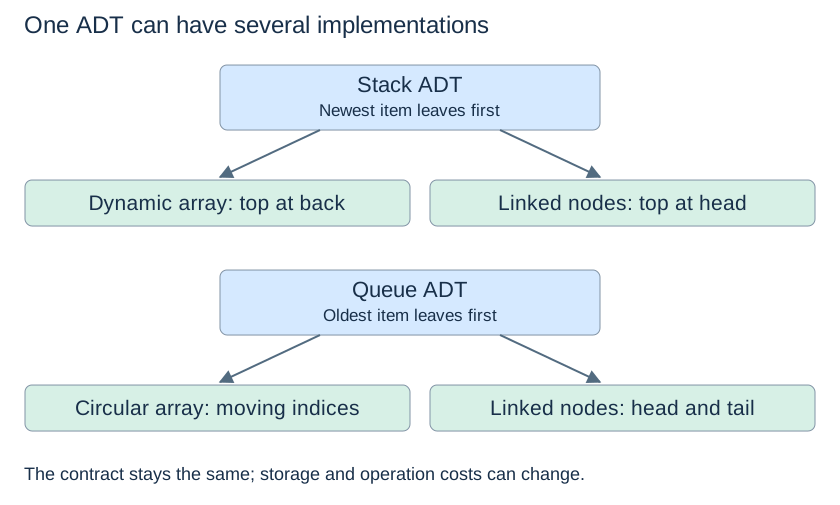
Correctness and efficiency are separate questions. list.append(x) paired with list.pop(0) produces correct FIFO behaviour, but every front removal shifts the remaining references. A circular array preserves FIFO without those shifts.
Linear order and positional access
In a linear collection, items have a sequential order. This logical arrangement does not require the objects to occupy neighbouring memory locations. Linked nodes also form a linear sequence.
A List or Sequence ADT exposes positions through operations such as get(i), set(i, x), insert(i, x) and remove_at(i). Here remove_at means removal by position; Python’s list.remove(x) instead searches for a value. After insertion or removal, later positions change. Starting with [A, B, C, D], removing position 1 gives [A, C, D]; setting position 1 to X then gives [A, X, D].
Stack and queue interfaces deliberately expose fewer access choices. Those restrictions express the intended policy and make accidental violations harder. Choose the policy from the problem before choosing a familiar Python container.
Check your understanding
Predict the operation result and the resulting state before opening the explanation.
1. Can front() and dequeue() return the same record yet behave differently?
Show explanation
Yes. Front leaves it stored; dequeue removes it. The post-state distinguishes the operations.
2. Do we need a separate extract method beside queue dequeue?
Show explanation
Not for this contract: dequeue already removes and returns the selected record.
Next: Sequence operations, followed by stacks, queues and deques.