After this page, you should be able to:
Preserve head/tail/size invariants through first insertion and last removal.
Compare node-based queue costs with fixed circular storage.
Builds on: Queue contracts and the Node class.
Code languages: Python defines the explanations, figures and self-checks. Use the language guide for native conventions and dependencies. Complete runnable topic examples: Python · JavaScript · Julia.
Julia uses one-based positions and named functions such as enqueue! rather than Python-style instance methods. Endpoint adapters use the supplied linked DequeBuffer, so they do not hide linear array-front shifts. Empty operations reject the request; null/nothing remain valid payloads.
Operation contract for this implementation
Use the same FIFO operation table. Enqueue returns None; front observes; dequeue removes and returns the earliest waiting record. size() and len(q) return the stored count. Empty front/dequeue raise IndexError before mutation. This version has no configured capacity or full-state rejection. Duplicates and None are allowed.
Head removes; tail appends
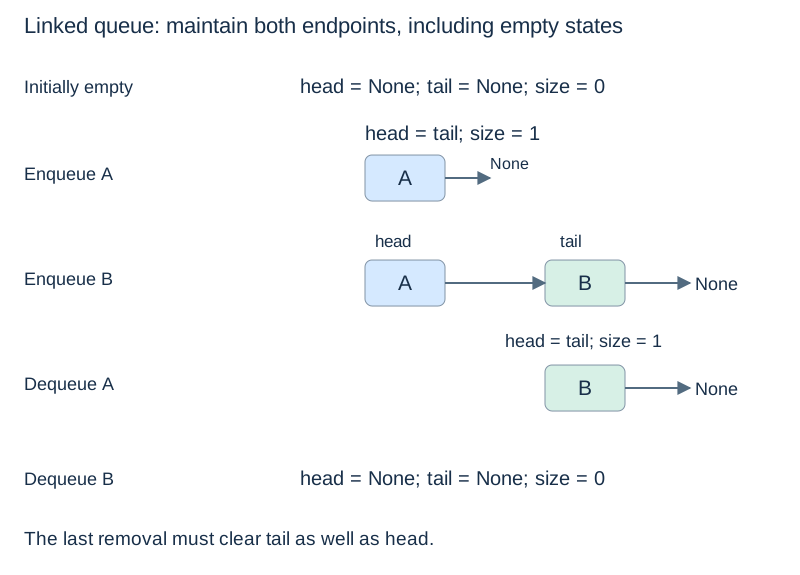
A singly linked queue places the oldest item at head and the newest at tail. Dequeue removes the head; enqueue links a new node after the tail. Holding both references avoids traversing the chain to append.
State the endpoint invariant
The maintained rules are:
The chain from head contains all queued items in arrival order.
The last node is tail and its
nextisNone.The stored size equals the number of reachable nodes.
The queue is empty exactly when size is zero and both head and tail are
None.
The empty case matters twice: adding the first item must establish both endpoints, and removing the last item must clear both endpoints.
Implement the two transitions explicitly
This code reuses the Node class from Linked structures. It does not impose a fixed capacity.
class LinkedQueue:
    def __init__(self):
        self._head = None
        self._tail = None
        self._size = 0

    def __len__(self):
        return self._size

    def size(self):
        return len(self)

    def is_empty(self):
        return self._size == 0

    def enqueue(self, item):
        new = Node(item)
        if self.is_empty():
            self._head = new
        else:
            self._tail.next = new
        self._tail = new
        self._size += 1

    def front(self):
        if self.is_empty():
            raise IndexError("front of empty queue")
        return self._head.value

    def dequeue(self):
        if self.is_empty():
            raise IndexError("dequeue from empty queue")
        removed = self._head
        self._head = removed.next
        self._size -= 1
        if self._head is None:
            self._tail = None
        removed.next = None
        return removed.value
class LinkedQueue {
constructor() { this._head = null; this._tail = null; this._size = 0; }
size() { return this._size; }
is_empty() { return this._size === 0; }
enqueue(item) {
const added = new Node(item);
if (this.is_empty()) this._head = added; else this._tail.next = added;
this._tail = added; this._size++;
}
front() { if (this.is_empty()) throw new RangeError("empty queue"); return this._head.value; }
dequeue() {
const item = this.front(), removed = this._head;
this._head = removed.next; this._size--;
if (this._head === null) this._tail = null;
removed.next = null; return item;
}
}mutable struct LinkedQueue
head
tail
n::Int
end
LinkedQueue() = LinkedQueue(nothing, nothing, 0)
Base.length(q::LinkedQueue) = q.n
Base.isempty(q::LinkedQueue) = q.n == 0
function enqueue!(q::LinkedQueue, item)
added = Node(item)
if isempty(q); q.head = added; else; q.tail.next = added; end
q.tail = added; q.n += 1; return nothing
end
function queue_front(q::LinkedQueue)
isempty(q) && throw(BoundsError())
return q.head.value
end
function dequeue!(q::LinkedQueue)
item = queue_front(q); removed = q.head
q.head = removed.next; q.n -= 1
q.head === nothing && (q.tail = nothing)
removed.next = nothing; return item
endOn the first enqueue, new.next is already None; assigning head and tail to the same node establishes the invariant. On later enqueues, link the old tail to the new node before changing tail.
On dequeue, save the old head, move head to its successor, and reduce size. If there is no successor, the queue is now empty, so tail must become None too. Otherwise it would retain a reference to an object that is no longer in the queue. The removed node is detached after head has been updated.
The tail removes a search, not all constraints
Each operation touches a constant number of nodes and fields, giving time under the standard model that treats allocating one fixed-size node as constant time. Real memory allocation can have additional costs. The queue uses node storage for queued items, with per-node reference and object overhead.
Without tail, enqueue must find the final node and can take time. Conversely, holding tail does not make removing the tail constant time in this singly linked representation: finding its predecessor may still require traversal. That distinction explains why a singly linked queue is not automatically an efficient deque.
Implementation choices and suitability
Cached head, tail and size make every exposed operation O(1) under the fixed-size-node allocation model. Updates use O(1) working storage, including a new node on enqueue; persistent storage is O(n+1). Nodes avoid copying the whole queue on growth but require per-item allocation and links. Choose this representation for changing queue size when indexed access is unnecessary.
Check your understanding
Predict the operation result and the resulting state before opening the explanation.
1. Enqueue A, dequeue it, then enqueue B. Which endpoints refer to B?
Show explanation
Both head and tail; B.next is None and size is one.
2. Which queue operation becomes linear if tail is not maintained?
Show explanation
Appending at the back: the final node must be found by traversal.