After this page, you should be able to:
Trace traversal and safe link updates without losing a suffix.
Separate locating a position from constant-link changes at a known node.
Builds on: Object references and the sequence contract.
Code languages: Python defines the explanations, figures and self-checks. Use the language guide for native conventions and dependencies. Complete runnable topic examples: Python · JavaScript · Julia.
Julia uses one-based positions and named functions such as enqueue! rather than Python-style instance methods. Endpoint adapters use the supplied linked DequeBuffer, so they do not hide linear array-front shifts. Empty operations reject the request; null/nothing remain valid payloads.
Operation contracts and representation invariant
A finite acyclic chain represents records in link order. linked_values(head) returns a new list without changing the chain. The insertion trace adds after a known node, while remove_after(node) removes and returns its successor’s value, raising IndexError if none exists. These are low-level known-node operations, not a complete positional List class. A positional insert(i,x) must locate the predecessor first; compare the sequence contract.
The links establish the sequence
A singly linked node stores a value and a reference to its successor. The head refers to the first node; the last node’s next is None. An empty chain has head = None. Nodes need not occupy consecutive memory locations.
class Node:
    def __init__(self, value, next_node=None):
        self.value = value
        self.next = next_node

c = Node("C")
b = Node("B", c)
head = Node("A", b)
class Node {
constructor(value, next_node = null) { this.value = value; this.next = next_node; }
}
var c = new Node("C"), b = new Node("B", c), head = new Node("A", b);mutable struct Node
value
next
end
Node(value) = Node(value, nothing)
c = Node("C"); b = Node("B", c); head = Node("A", b)This is the same reference idea as Topic 1’s route nodes, with a generic value field. The node and its payload are separate concepts: the node supplies a position in the chain.
Traverse without changing the links
def linked_values(head):
    values = []
    current = head
    while current is not None:
        values.append(current.value)
        current = current.next
    return values

assert linked_values(head) == ["A", "B", "C"]
function linked_values(head) {
const values = [];
for (let current = head; current !== null; current = current.next) values.push(current.value);
return values;
}
console.assert(JSON.stringify(linked_values(head)) === '["A","B","C"]');function linked_values(head)
values = Any[]; current = head
while current !== nothing
push!(values, current.value); current = current.next
end
return values
end
@assert linked_values(head) == ["A", "B", "C"]Before each iteration, current is the next unvisited node. Rebinding it advances the traversal; it does not change head or any link. Visiting nodes takes time. This collecting helper also uses output space; traversal that only processes each item needs auxiliary space apart from that processing.
The termination argument assumes a finite acyclic chain. A cycle can prevent current from reaching None. To retrieve index , follow links from the head, giving time for a valid index and worst-case access.
Preserve the successor before replacing its link
To insert X after the already-known node B, first connect X to B’s old successor C, then connect B to X.
new = Node("X")
new.next = b.next
b.next = new
assert linked_values(head) == ["A", "B", "X", "C"]
var added = new Node("X");
added.next = b.next; b.next = added;
console.assert(JSON.stringify(linked_values(head)) === '["A","B","X","C"]');added = Node("X")
added.next = b.next; b.next = added
@assert linked_values(head) == ["A", "B", "X", "C"]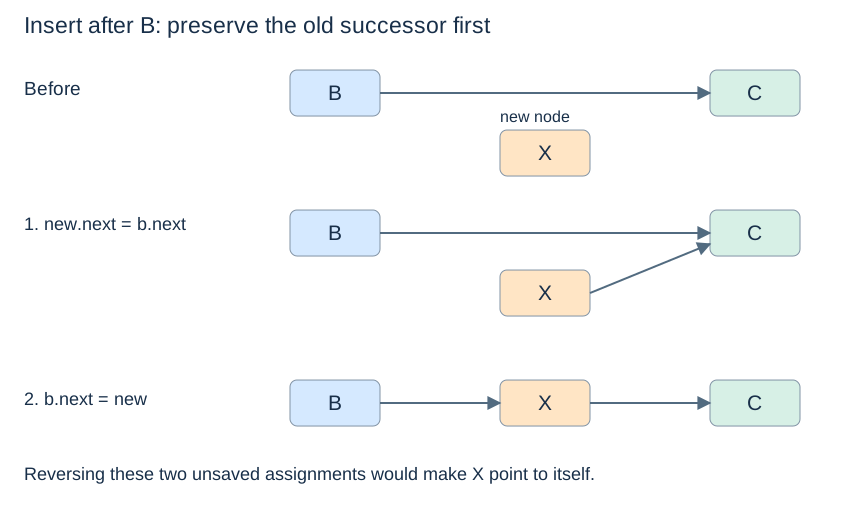
If we instead execute b.next = new followed by new.next = b.next, the second statement makes X point to itself. The old link to C has already been overwritten. A separately saved successor reference would permit another safe ordering, but the old remainder must remain reachable somewhere.
Bypass the unwanted node
To remove the node after B, redirect B to that node’s successor. Require that B has a successor; otherwise there is no node to remove.
def remove_after(node):
    if node.next is None:
        raise IndexError("no successor to remove")
    removed = node.next
    node.next = removed.next
    removed.next = None
    return removed.value

assert remove_after(b) == "X"
assert linked_values(head) == ["A", "B", "C"]
function remove_after(node) {
if (node.next === null) throw new RangeError("no successor");
const removed = node.next; node.next = removed.next; removed.next = null;
return removed.value;
}
console.assert(remove_after(b) === "X");
console.assert(JSON.stringify(linked_values(head)) === '["A","B","C"]');function remove_after!(node)
node.next === nothing && throw(BoundsError())
removed = node.next; node.next = removed.next; removed.next = nothing
return removed.value
end
@assert remove_after!(b) == "X"
@assert linked_values(head) == ["A", "B", "C"]Detaching the removed node makes this operation’s intent explicit; other references may still keep that object alive. Removing the head instead requires updating the head reference itself. Structures that maintain a tail or a length must update that metadata too.
Finding the place differs from changing it
Insertion after a known node and removal after a known predecessor change only a constant number of references: work. Finding that node by value or index may first cost . Merely holding the node to delete does not generally supply its predecessor in a singly linked list.
A second link supports the reverse direction
A doubly linked node also stores prev. For adjacent nodes, u.next is v must agree with v.prev is u. With head and tail references, both-end insertion and removal can be constant time, and a known node can be removed by reconnecting both neighbours.
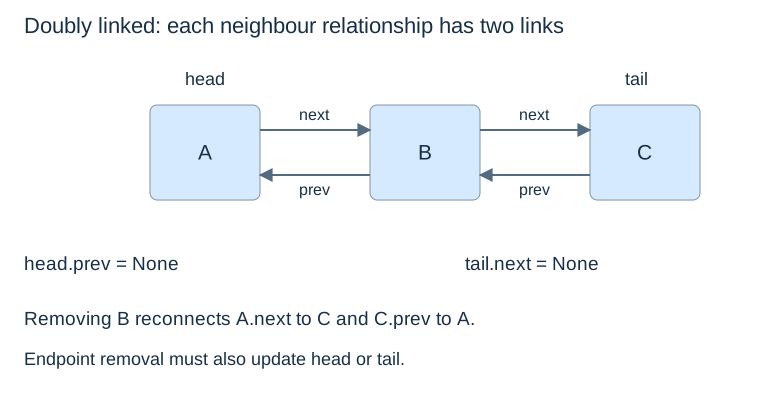
The benefit costs one extra link per node and more updates. The first and last nodes need endpoint handling; the only node requires changing both head and tail to None. Extra metadata makes more operations cheap only when its invariants are maintained.
Implementation choices, space and suitability
A singly linked node stores one successor; a doubly linked node also stores a predecessor. Maintaining tail and size fields can speed append and size queries, but every update must preserve them. A traversal with only a cursor uses O(1) workspace; collecting its n outputs uses O(n) result storage. An insertion allocates one node; removal updates O(1) links after the predecessor is known. Persistent storage is O(n+1), with per-node overhead.
Use links when endpoint or known-node updates matter. Prefer arrays when frequent indexed access and locality dominate. The code here deliberately illustrates reference updates; the linked queue adds complete endpoint and size maintenance.
Check your understanding
Predict the operation result and the resulting state before opening the explanation.
1. Why assign new.next before replacing b.next in the insertion trace?
Show explanation
It preserves the old successor C before overwriting B’s outgoing link.
2. Does holding tail make removal of a singly linked tail O(1)?
Show explanation
No. Its predecessor is still needed to repair the new tail link.
Next: Circular-array queues.