After this page, you should be able to:
Trace both-end additions, observations and removals under one contract.
Compare endpoint costs and distinguish eviction from full-queue rejection.
Builds on: Queues restrict additions/removals to opposite ends; here both ends are exposed.
Code languages: Python defines the explanations, figures and self-checks. Use the language guide for native conventions and dependencies. Complete runnable topic examples: Python · JavaScript · Julia.
Julia uses one-based positions and named functions such as enqueue! rather than Python-style instance methods. Endpoint adapters use the supplied linked DequeBuffer, so they do not hide linear array-front shifts. Empty operations reject the request; null/nothing remain valid payloads.
A deque exposes both ends
A deque (double-ended queue) allows insertion and removal at both ends. Distinguish the container name deque from the queue operation dequeue.
| Operation | Returned result | State change or empty policy | Library mapping |
|---|---|---|---|
add_first(x) | None | Add at front | appendleft(x) |
add_last(x) | None | Add at back | append(x) |
peek_first() | Front item | Observe; empty raises IndexError | d[0] |
peek_last() | Back item | Observe; empty raises IndexError | d[-1] |
remove_first() | Front item | Remove; empty raises IndexError | popleft() |
remove_last() | Back item | Remove; empty raises IndexError | pop() |
size() / len(d) | Number of items | Observe | len(d) |
is_empty() | Boolean | Observe | len(d) == 0 |
The interface below is unbounded: it does not automatically discard an item. Repeated values and None are valid. Empty observations/removals raise before changing state. “First” and “last” identify ends, not minimum and maximum keys.
Representation, invariant and trace
The wrapped library deque stores exactly the logical records, from first to last. All methods preserve that order except for the one endpoint addition/removal requested. The next listing uses library names to show the underlying operations directly:
from collections import deque

items = deque()
items.append("B")
items.appendleft("A")
items.append("C")
assert items.pop() == "C"
items.appendleft("X")
assert items.popleft() == "X"
assert list(items) == ["A", "B"]
// Use the shared linked DequeBuffer; JavaScript has no built-in deque.
var items = new DequeBuffer();
items.add_last("B"); items.add_first("A"); items.add_last("C");
console.assert(items.remove_last() === "C");
items.add_first("X");
console.assert(items.remove_first() === "X");
console.assert(JSON.stringify([...items]) === '["A","B"]');items = DequeBuffer()
db_add_last!(items, "B"); db_add_first!(items, "A"); db_add_last!(items, "C")
@assert db_remove_last!(items) == "C"
db_add_first!(items, "X")
@assert db_remove_first!(items) == "X"
@assert db_values(items) == ["A", "B"]Python implementation with the ADT names
from collections import deque

class Deque:
    def __init__(self):
        self._items = deque()

    def __len__(self):
        return len(self._items)

    def size(self):
        return len(self)

    def is_empty(self):
        return len(self) == 0

    def add_first(self, item):
        self._items.appendleft(item)

    def add_last(self, item):
        self._items.append(item)

    def peek_first(self):
        if self.is_empty():
            raise IndexError("first of empty deque")
        return self._items[0]

    def peek_last(self):
        if self.is_empty():
            raise IndexError("last of empty deque")
        return self._items[-1]

    def remove_first(self):
        if self.is_empty():
            raise IndexError("remove first from empty deque")
        return self._items.popleft()

    def remove_last(self):
        if self.is_empty():
            raise IndexError("remove last from empty deque")
        return self._items.pop()
class Deque {
constructor() { this._items = new DequeBuffer(); }
size() { return this._items.size(); }
is_empty() { return this.size() === 0; }
add_first(item) { this._items.add_first(item); }
add_last(item) { this._items.add_last(item); }
peek_first() { return this._items.peek_first(); }
peek_last() { return this._items.peek_last(); }
remove_first() { return this._items.remove_first(); }
remove_last() { return this._items.remove_last(); }
}mutable struct Deque
items::DequeBuffer
end
Deque() = Deque(DequeBuffer())
Base.length(q::Deque) = q.items.n
Base.isempty(q::Deque) = length(q) == 0
add_first!(q::Deque, x) = db_add_first!(q.items, x)
add_last!(q::Deque, x) = db_add_last!(q.items, x)
peek_first(q::Deque) = db_first(q.items)
peek_last(q::Deque) = db_last(q.items)
remove_first!(q::Deque) = db_remove_first!(q.items)
remove_last!(q::Deque) = db_remove_last!(q.items)Implementation choices and correctness
The methods delegate to the corresponding endpoint, so each successful removal returns and removes exactly that endpoint record. The wrapper keeps the abstract names consistent without recreating the library’s internals. A circular buffer or a doubly linked chain is an alternative representation. A singly linked chain with only head/tail references still needs a predecessor search to remove its tail.
Time and space costs
All operations in the table use O(1) time in the ordinary endpoint-operation model and O(1) wrapper workspace. The underlying library describes endpoint updates as approximately constant time. Storage is O(n+1) for n live items; payload objects are not copied by endpoint operations. These are not guarantees of hard real-time allocation.
Python’s deque supports approximately constant-time additions and removals at either end. Indexed access near the middle is linear, so a deque is not a replacement for an array when arbitrary indexed access dominates. Empty endpoint removal or inspection raises IndexError.
A deque can implement stack behaviour by using only one end, or queue behaviour by adding at one end and removing at the other. A restricted stack or queue interface can still communicate the intended policy more clearly.
When to use it: keep the latest readings
To retain the latest four readings, add each new reading at the back and discard the oldest at the front when the window exceeds four items.
window = deque([12, 15, 14, 18])
window.append(20)
if len(window) > 4:
    window.popleft()
assert list(window) == [15, 14, 18, 20]
var window = new DequeBuffer([12, 15, 14, 18]);
window.add_last(20);
if (window.size() > 4) window.remove_first();
console.assert(JSON.stringify([...window]) === "[15,14,18,20]");window = DequeBuffer([12, 15, 14, 18])
db_add_last!(window, 20)
window.n > 4 && db_remove_first!(window)
@assert db_values(window) == [15, 14, 18, 20]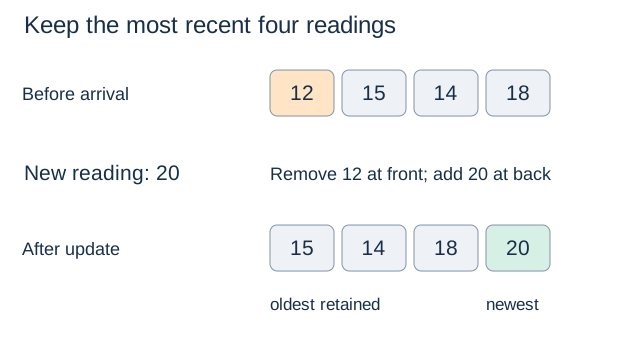
The invariant after each update is: the window contains the most recent at most four readings, in arrival order. This policy intentionally discards old data. A bounded deque(maxlen=4) can perform that eviction automatically on append, while a bounded queue may instead reject an insertion when full. These are different contracts.
Compare the front and back
A palindrome reads the same in both directions. A deque can hold its characters: repeatedly remove and compare both ends until fewer than two remain. RACECAR gives matching pairs R/R, A/A and C/C, with E left in the middle.
def is_palindrome(sequence):
    remaining = deque(sequence)
    while len(remaining) > 1:
        if remaining.popleft() != remaining.pop():
            return False
    return True
function is_palindrome(sequence) {
const remaining = new DequeBuffer(sequence);
while (remaining.size() > 1)
if (remaining.remove_first() !== remaining.remove_last()) return false;
return true;
}function is_palindrome(sequence)
remaining = DequeBuffer(sequence)
while remaining.n > 1
db_remove_first!(remaining) != db_remove_last!(remaining) && return false
end
return true
endThis checks exact element equality: it does not remove spaces or normalise case. Building and scanning the deque takes time and additional space for input elements. Two indices into an existing sequence can avoid that extra copy; the deque version illustrates the access policy.
Check your understanding
Predict the operation result and the resulting state before opening the explanation.
1. Add B at the back, A at the front and C at the back; remove last. What is returned and what remains?
Show explanation
C is returned; A,B remain from first to last.
2. Does a full rolling window have to raise OverflowError on a new reading?
Show explanation
No. The rolling-window contract intentionally evicts an old reading. A bounded queue that promises rejection has a different policy.
Reference: Python deque documentation. Next: Arrays and positional operations.