After this page, you should be able to:
Trace suspended DFS calls and distinguish discovery from completion.
Specify DFS results, recursion costs and the extra state required by extensions.
Builds on: Recursive call frames and BFS state/results.
Code languages: Python defines the explanations, figures and self-checks. Use the language guide for native conventions and dependencies. Complete runnable topic examples: Python · JavaScript · Julia.
JavaScript graphs use Map; Julia graphs use Dict. Stored neighbour order is preserved, but Julia Dict vertex iteration can change valid component ordering or tied choices. The shared DequeBuffer supplies constant-time linked endpoints. The figures and check answers use Python’s declared iteration order.
Finish a branch before resuming its caller
Depth-first search (DFS) explores an undiscovered neighbour immediately, continuing deeper until it must return. Recursion supplies the stack of waiting calls. Each caller resumes at its next unchecked neighbour after the deeper call finishes.
The input is the same adjacency-list graph as for BFS. We keep its alphabetical neighbour order, so differences in the traces come from the frontier policy.
Specify discovery, completion and parents
dfs(graph, start) returns (discovery, finish, parent) for the reachable region and leaves the input unchanged. Each reached vertex occurs once in each order. The start’s parent is None; every other parent is the actual edge that first discovered it. Invalid starts raise KeyError. Use non-None labels if reusing path recovery.
Neighbour order fixes this implementation’s exact trace, but not the set of reached vertices. The function does not return shortest distances, classify every edge, or report cycles. An empty graph has no valid single start; component traversal instead handles an empty full graph.
Mark on entry and finish after neighbour checks
def dfs(graph, start):
    if start not in graph:
        raise KeyError(start)
    seen = set()
    parent = {start: None}
    discovery, finish = [], []

    def visit(u):
        seen.add(u)
        discovery.append(u)
        for v in graph[u]:
            if v not in seen:
                parent[v] = u
                visit(v)
        finish.append(u)

    visit(start)
    return discovery, finish, parent
function dfs(graph, start) {
if (!graph.has(start)) throw new KeyError(String(start));
const seen = new Set(), parent = new Map([[start, null]]), discovery = [], finish = [];
function visit(u) {
seen.add(u); discovery.push(u);
for (const v of graph.get(u)) if (!seen.has(v)) { parent.set(v, u); visit(v); }
finish.push(u);
}
visit(start); return [discovery, finish, parent];
}function dfs(graph, start)
haskey(graph, start) || throw(KeyError(start))
seen = Set{Any}(); parent = Dict{Any,Any}(start=>nothing); discovery = Any[]; finish = Any[]
function visit(u)
push!(seen, u); push!(discovery, u)
for v in graph[u]
if !(v in seen); parent[v] = u; visit(v); end
end
push!(finish, u)
end
visit(start); return (discovery, finish, parent)
endDiscovery and completion are different events
A vertex is discovered when its call begins. It completes only after all its neighbours have been checked and all child calls have returned. Some discovered vertices are still active on the stack; others have already finished.
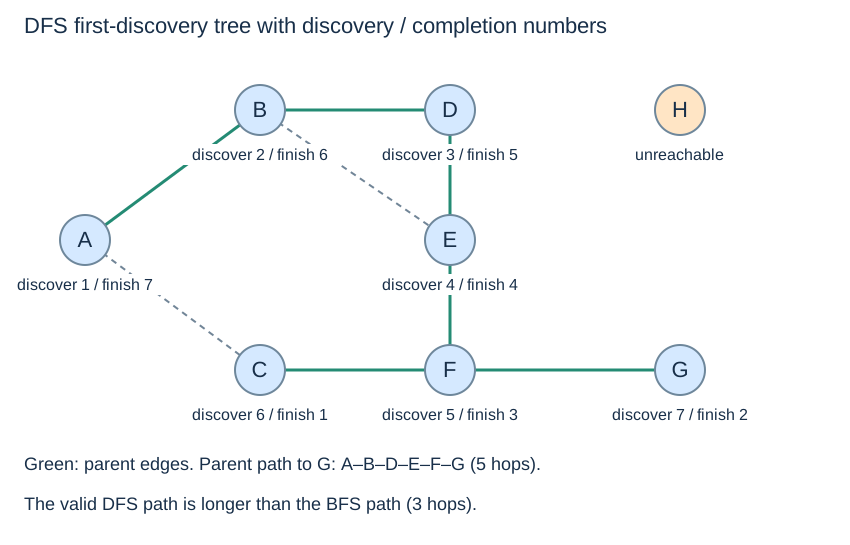
For the shared graph, discovery order from A is A, B, D, E, F, C, G. Completion order is C, G, F, E, D, B, A. Completion is not generally the reverse of discovery: F discovers both C and G, finishing C before G is even discovered.
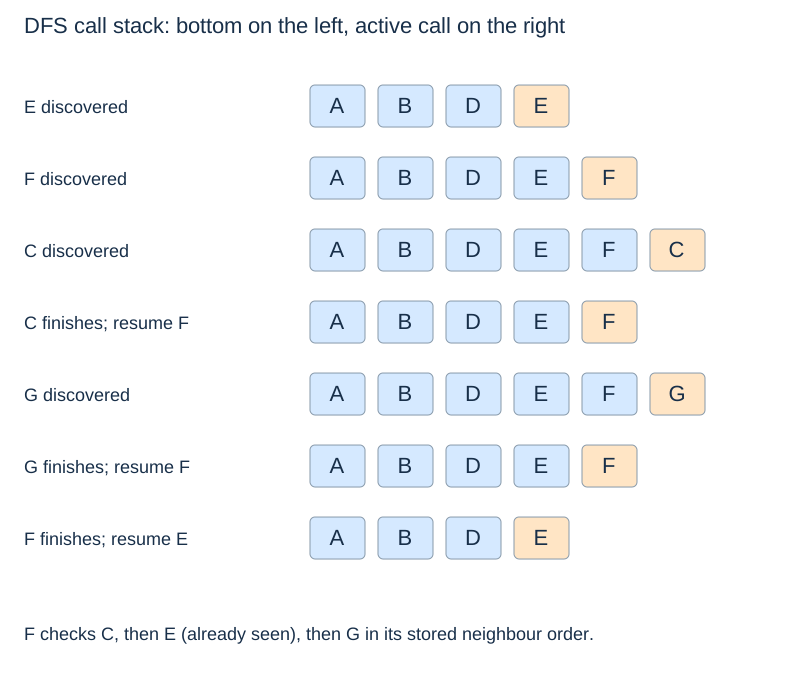
When C returns, A’s original call is still waiting on the branch through B. A’s neighbour C will later be skipped because C was already reached through F. Return order describes waiting work, not a rule that every vertex returns immediately after discovery.
A DFS path need not minimise hops
The first-discovery parents give the route A, B, D, E, F, G to G: five edges. BFS finds A, C, F, G, with three. Both are valid paths; the DFS code has no shortest-hop guarantee.
Seeing a discovered neighbour does not always mean a cycle
The seen set prevents a cycle such as B–D–E–B from making recursion repeat forever. In an undirected graph, however, a child also sees its parent as already discovered. That reverse appearance of the tree edge alone does not establish a cycle. An undirected cycle detector must distinguish the parent edge from other revisits.
In directed DFS, an edge to an active ancestor can establish a directed cycle, while an edge to an already finished vertex need not. A single discovered set does not distinguish those two states. Cycle detection needs additional state beyond the traversal shown here.
An explicit stack must remember where to resume
A stack can replace recursion, which is useful when a long path would exceed Python’s recursion limit. But pushing all neighbours at once can change discovery order or parents, depending on push order and when vertices are marked.
To reproduce the recursive trace exactly, each explicit frame needs the active vertex and its next-neighbour position or iterator. Descend when it finds an undiscovered neighbour; finish and pop the frame only when its neighbour sequence is exhausted. This matches the suspended work in a recursive call.
DFS may have active calls in a graph with n vertices. Linear total work therefore does not imply a small call stack. For a full graph rather than just one start’s reachable region, continue to components and restarts.
Correctness, costs and suitability
Marking on entry means each reachable vertex starts one call. Each call advances through a finite neighbour sequence and finishes after its child calls, so revisits cannot cause endless recursion. In abstract execution, time is O(n_R+m_R+1), with O(n_R+1) working storage for seen/call frames and O(n_R+1) returned order/parent storage. These inherit expected dictionary/set costs.
Python has a finite recursion limit: a long chain can raise RecursionError before the mathematical traversal finishes. An explicit stack of iterator frames avoids that language limit and can reproduce discovery and finish events. A simple stack of pending vertices is a different implementation choice and need not reproduce the exact recursive trace.
Use DFS for reachability and nesting/completion reasoning. Directed-cycle detection needs active/finished states; strongly connected components require further algorithms. Those are extensions to the shown traversal, not outputs hidden in its single seen set.
Check your understanding
Predict the result or state change before opening the explanation.
1. In the shared trace, C finishes before G is discovered. Is that consistent with DFS?
Show explanation
Yes. F finishes exploring C, resumes its neighbour iteration, then enters G. Both are descendants explored while F is active.
2. Does an edge to a discovered vertex prove a directed cycle?
Show explanation
No. The destination might already be finished. An edge to an active ancestor is the relevant directed-cycle evidence; one seen set does not distinguish these states.