After this page, you should be able to:
Read the same graph from lists and a matrix, including isolated vertices.
Choose a representation by membership, neighbour enumeration, updates and storage.
Builds on: Graph modelling, reference sharing and hashing assumptions.
Code languages: Python defines the explanations, figures and self-checks. Use the language guide for native conventions and dependencies. Complete runnable topic examples: Python · JavaScript · Julia.
JavaScript graphs use Map; Julia graphs use Dict. Stored neighbour order is preserved, but Julia Dict vertex iteration can change valid component ordering or tied choices. The shared DequeBuffer supplies constant-time linked endpoints. The figures and check answers use Python’s declared iteration order.
Store each vertex’s neighbours
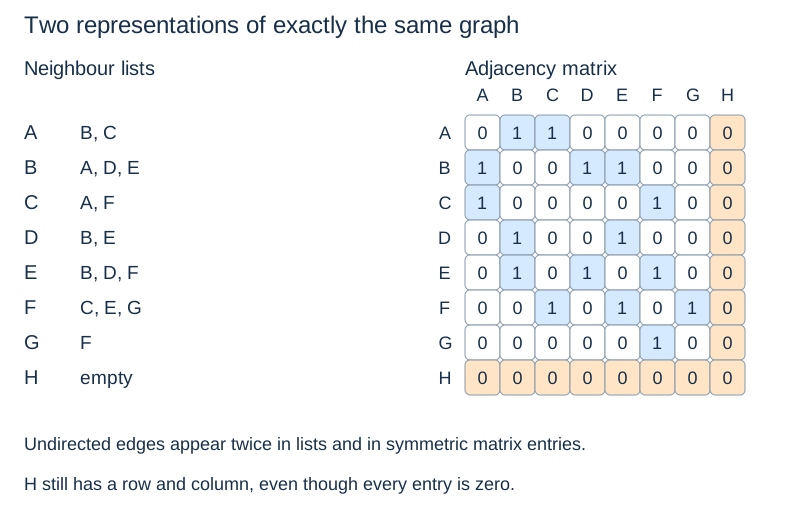
An adjacency list records the neighbours reachable by one edge from each vertex. In Python, a dictionary can map each label to a list. Lists give a specified iteration order; this example uses alphabetical neighbour order.
graph = {
    "A": ["B", "C"],
    "B": ["A", "D", "E"],
    "C": ["A", "F"],
    "D": ["B", "E"],
    "E": ["B", "D", "F"],
    "F": ["C", "E", "G"],
    "G": ["F"],
    "H": [],
}
var graph = new Map([
["A", ["B", "C"]], ["B", ["A", "D", "E"]], ["C", ["A", "F"]],
["D", ["B", "E"]], ["E", ["B", "D", "F"]], ["F", ["C", "E", "G"]],
["G", ["F"]], ["H", []]
]);graph = Dict("A"=>["B","C"], "B"=>["A","D","E"], "C"=>["A","F"],
"D"=>["B","E"], "E"=>["B","D","F"], "F"=>["C","E","G"], "G"=>["F"], "H"=>String[])Keep vertices and edges consistent
Every vertex, including H, appears as a key. Every listed neighbour must also be a key. Undirected lists are reciprocal: B in A’s list requires A in B’s list. A directed representation instead lists outgoing neighbours, without automatically adding the reverse edge.
The eight undirected edges occupy sixteen neighbour entries because each appears at both endpoints. The empty list at H records an isolated vertex; omitting H would represent a different vertex set.
Store an entry for every ordered pair
Fix the vertex order A through H. An adjacency matrix has entry 1 in row u, column v when the edge exists, and 0 otherwise. An undirected graph’s matrix is symmetric; a directed graph’s need not be. The diagonal is zero for this graph because it has no self-loops.
vertices = list(graph)
index = {v: i for i, v in enumerate(vertices)}
n = len(vertices)
matrix = [[0] * n for _ in range(n)]
for u in vertices:
    for v in graph[u]:
        matrix[index[u]][index[v]] = 1
var vertices = [...graph.keys()], index = new Map(vertices.map((v, i) => [v, i]));
var matrix = Array.from({length: vertices.length}, () => Array(vertices.length).fill(0));
for (const u of vertices) for (const v of graph.get(u)) matrix[index.get(u)][index.get(v)] = 1;vertices = collect(keys(graph))
index = Dict(v=>i for (i,v) in enumerate(vertices))
matrix = zeros(Int, length(vertices), length(vertices))
for u in vertices, v in graph[u]; matrix[index[u], index[v]] = 1; endEach row is a separate list. [[0] * n] * n would alias a single row: changing one entry would unexpectedly change the same column in every row. This is the reference-sharing issue from Topic 1.
Ask which operation needs to be fast
Let and , with constant-time label hashing, comparisons and indexed access.
| Operation or storage | Dictionary of neighbour lists | Matrix plus label-to-index map |
|---|---|---|
| Input storage | ||
| Test whether u–v exists | scan | entry lookup |
| Enumerate neighbours of u | entries | row scan |
| Initialise the shown structure | Depends on supplied vertices and edges | zero initialisation |
A neighbour set can provide expected constant-time membership at the cost of an additional ordering decision for exact traces. That is a different representation from the lists above.
Space depends on how many edges exist
A sparse graph has relatively few edges compared with the possible number of vertex pairs. A dense graph has many. Adjacency lists avoid allocating a slot for every absent edge, making them attractive for sparse networks. A matrix can be useful when pairwise edge tests dominate and quadratic storage is acceptable.
For weighted matrices, choose an explicit no-edge marker rather than using zero if zero-weight edges are legal. For weighted lists, store each neighbour together with its weight. Neither extension changes the distinction between a connection and its cost.
Construction, updates and implementation choices
The matrix code assumes the supplied adjacency lists already satisfy the contract. It allocates n distinct rows, then fills entries: Θ(n²+m+1) time and Θ(n²+1) output storage. For a simple graph, m is at most quadratic. The index dictionary adds Θ(n+1) storage and expected constant-time label-to-row lookup.
Lists preserve supplied neighbour order and are easy to inspect in traces. Sets improve expected edge membership/update costs but require an explicit ordering policy for reproducible traversal. Matrices make edge tests/updates constant-time after allocation; they do not make neighbour enumeration constant-time. See the complete update route for insertion and deletion, including matrix vertex-management choices.
The 0/1 matrix here is unweighted. A weighted representation needs a separate absent-edge marker when weight zero is legal. Weighted lists later use (neighbour, weight) entries, while edge-list algorithms use (weight, u, v) records; check the interface before passing one format to another.
Check your understanding
Predict the result or state change before opening the explanation.
1. Why does isolated H need a dictionary key and a matrix row/column?
Show explanation
It belongs to the vertex set. Dropping it changes component counts and any result that must cover all vertices.
2. For a sparse graph, must a matrix save space because most entries are zero?
Show explanation
No. The shown dense matrix still allocates all n² entries. An adjacency list omits absent connections.
Next: Graph operations, then breadth-first search.