After this page, you should be able to:
Distinguish vertex/edge models, direction, weights and graph simplicity.
Explain reachability, path length and degree without reading geometry as cost.
Builds on: ADT contracts and sets/maps.
Decide what the connections mean
A graph has a set of vertices and a collection of edges connecting them. A vertex can represent a junction, webpage, task or person; an edge represents the relationship needed by the question. An edge’s meaning must be stated before interpreting a path.
For a transport model, junctions might be vertices and traversable road segments edges. For a course model, vertices could be courses and an arrow from one to another could mean “must be completed before.” The same drawing can encode different problems under different modelling choices.
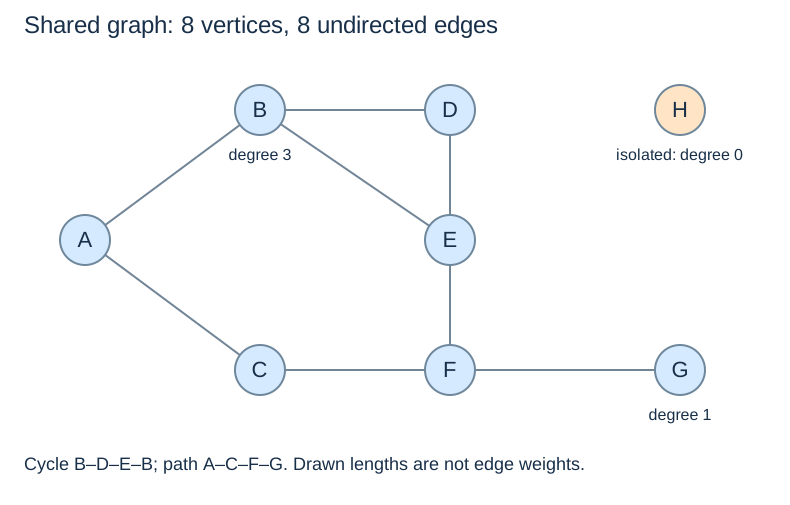
Our shared edges are AB, AC, BD, BE, CF, DE, EF and FG. A line represents a connection, not a measured road length. H is a vertex even though it has no incident edge.
Direction changes which moves are permitted
An undirected edge joins two vertices in both directions. A directed edge, or arc, has a source and destination. A → B permits a move from A to B but does not imply a move from B to A. Reachability must follow the arrows.
A weight is separate from the connection
A weighted edge carries a value such as travel time, length or cost. An unweighted graph treats every traversed edge as one hop. The route with the fewest edges can differ from the route with the smallest weight sum.
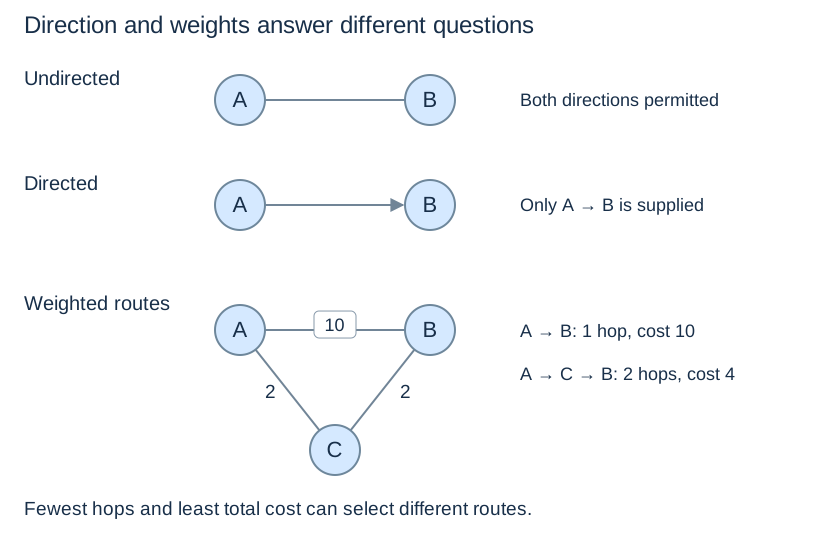
For example, a direct edge costing 10 is more expensive than two edges costing 2 each. BFS minimises hops in an unweighted graph; a weighted shortest-path algorithm must use the actual edge costs. This topic does not treat visual line lengths as weights.
Paths, cycles and reachability
A walk follows consecutive edges and can repeat vertices. A path here does not repeat vertices. A cycle returns to its starting vertex without repeating the other vertices. In a simple undirected graph, going out along an edge and immediately returning along that same edge is not treated as a cycle.
In the shared graph, A–C–F–G is a path of three edges. B–D–E–B is a cycle. G is reachable from A because some permitted path connects them; H is not. A path’s unweighted length counts edges, so a path containing four vertices has length three. The zero-edge path makes a vertex reachable from itself.
Degree counts incident connections
In a simple undirected graph, a vertex’s degree is its number of neighbours. B has degree 3, G has degree 1, and H has degree 0. Each edge contributes to two vertex degrees, so the shared degree sum is .
In a directed graph, outdegree counts outgoing edges and indegree counts incoming edges; their totals each equal the number of directed edges. Our teaching graph is simple: it has no self-loops and no repeated parallel edges. Other models can allow these, but their representations and counting conventions must say so.
Contract, representation and use
The model determines whether A–B and B–A are one edge or two arcs, whether parallel connections exist, and what an edge weight measures. Our core examples are simple graphs with explicit isolated vertices. Graph operations implement the unweighted simple case; weighted algorithms state additional conditions.
A graph is the relationship model; an adjacency list or matrix is a representation. Degree, reachability and shortest routes are distinct queries, so their costs cannot be inferred from the drawing alone. With n vertices and m edges, lists use Θ(n+m+1) storage and a matrix Θ(n²+1); representation costs explain the operations behind those bounds. Storing a graph does not precompute answers to every route query.
Check your understanding
Predict the result or state change before opening the explanation.
1. The path A–C–F–G contains four vertices. What is its unweighted length?
Show explanation
Three edges. Vertex count on a nonempty simple path is one more than its edge count.
2. If A→B exists, must B be able to reach A?
Show explanation
No. A reverse arc or another directed route is needed; the drawing of two nearby vertices does not supply one.
Next: Representing graphs.