After this page, you should be able to:
Explain nonnegative-weight settlement and identify obsolete heap entries.
Connect the lazy implementation to its result contract, tie policy and costs.
Builds on: Relaxation and stable heap records.
Code languages: Python defines the explanations, figures and self-checks. Use the language guide for native conventions and dependencies. Complete runnable topic examples: Python · JavaScript · Julia.
These versions reuse the translated deque, heap and disjoint-set definitions. Julia Dict order can select a different valid topological order or tied forest; compare the objective, feasibility and optimum cost rather than requiring an identical printed edge order. Heap counters avoid comparing payloads.
Settle the smallest current tentative distance
Under nonnegative edge weights, the smallest current tentative distance can be finalised. Any competing route through an unsettled vertex would reach that vertex at a cost at least as large, then add only nonnegative edges. It cannot lead back to a smaller answer for the selected vertex.
That is a greedy correctness argument, not just a statement that a heap is fast. Marking a vertex final when first inserted is wrong: B in the shared graph improves from 4 to 3 after its first insertion.
Specify weights, errors and tied results
dijkstra(graph, source) returns all-vertex (distance, parent) dictionaries under the shortest-path contract. It rejects a missing source with KeyError and any negative edge anywhere with ValueError, including an unreachable negative edge. Zero weights are allowed; finite numeric weights and valid destination keys are preconditions. An empty graph has no valid source.
The input remains unchanged. Strict relaxations retain the first equal-cost route already found; the counter resolves heap ties in candidate insertion order without comparing labels. The function computes distances for every source-reachable vertex and does not stop at one target.
Insert improved candidates and skip obsolete ones
from heapq import heappush, heappop
from itertools import count
from math import inf

def dijkstra(graph, source):
    if source not in graph:
        raise KeyError(source)
    if any(w < 0 for edges in graph.values() for _, w in edges):
        raise ValueError("Dijkstra requires nonnegative weights")
    distance = {v: inf for v in graph}
    parent = {v: None for v in graph}
    distance[source] = 0
    sequence = count()
    heap = [(0, next(sequence), source)]
    while heap:
        cost, _, u = heappop(heap)
        if cost != distance[u]:
            continue
        for v, w in graph[u]:
            candidate = cost + w
            if candidate < distance[v]:
                distance[v] = candidate
                parent[v] = u
                heappush(heap, (candidate, next(sequence), v))
    return distance, parent
function dijkstra(graph, source) {
if (!graph.has(source)) throw new KeyError(String(source));
for (const adjacent of graph.values()) for (const [v,w] of adjacent)
if (w < 0) throw new RangeError("Dijkstra requires nonnegative weights");
const distance = new Map([...graph.keys()].map(v => [v, Infinity]));
const parent = new Map([...graph.keys()].map(v => [v, null]));
distance.set(source, 0); let sequence = 0;
const heap = new MinHeap(entry_less); heap.push([0, sequence++, source]);
while (heap.size()) {
const [cost, serial, u] = heap.pop();
if (cost !== distance.get(u)) continue;
for (const [v,w] of graph.get(u)) {
const candidate = cost + w;
if (candidate < distance.get(v)) {
distance.set(v, candidate); parent.set(v, u); heap.push([candidate, sequence++, v]);
}
}
}
return [distance, parent];
}function dijkstra(graph, source)
haskey(graph, source) || throw(KeyError(source))
any(w < 0 for adjacent in values(graph) for (v,w) in adjacent) && throw(ArgumentError("Dijkstra requires nonnegative weights"))
distance = Dict(v=>Inf for v in keys(graph)); parent = Dict{Any,Any}(v=>nothing for v in keys(graph))
distance[source] = 0; sequence = 0; heap = MinHeap(entry_less)
heap_push!(heap, (0, sequence, source)); sequence += 1
while !isempty(heap.data)
cost, serial, u = heap_pop!(heap)
cost != distance[u] && continue
for (v,w) in graph[u]
candidate = cost + w
if candidate < distance[v]
distance[v] = candidate; parent[v] = u
heap_push!(heap, (candidate, sequence, v)); sequence += 1
end
end
end
return (distance, parent)
endThe listing includes all its imports. The counter resolves equal-cost heap ties without comparing vertex objects, as in priority-queue entries. The code checks negativity across the whole input, including unreachable edges. Its other input preconditions include finite weights and destinations that are graph keys.
A heap pop is not always a settlement
When B improves to 3, its old entry at 4 remains in the heap. The equality test discards that entry later. Successful relaxations create new candidates rather than modifying entries already inside the heap.
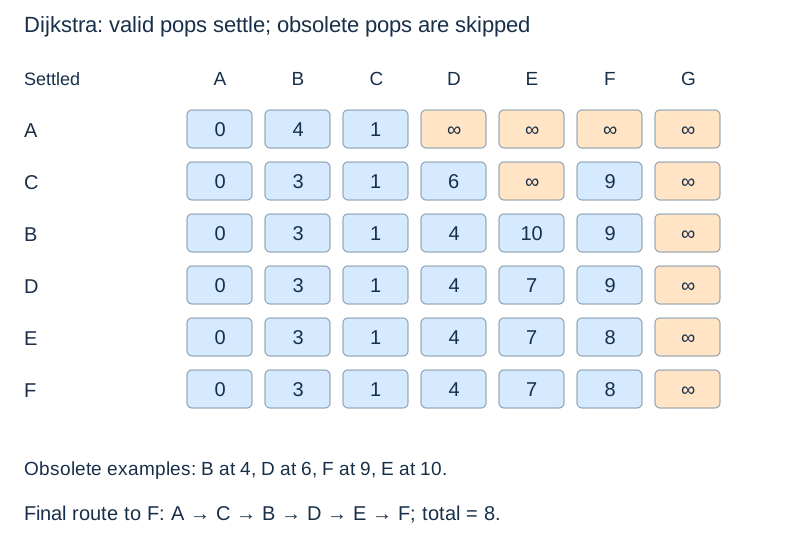
The settlement order is A, C, B, D, E, F; G never enters the heap. Zero-weight edges are permitted. A fixed vertex’s distance cannot improve after its valid pop under the preconditions, but obsolete candidates for it may still pop later.
Lazy storage changes the space bound
Each validly reached vertex scans its outgoing list once; each successful relaxation creates an entry, at most m across m edges. The heap can contain entries, so a push/pop costs .
Including initialisation and the whole-input weight check gives time and auxiliary storage for a nonempty graph. These assume expected constant-time dictionary operations and constant-cost arithmetic. For a simple graph, the usual time bound follows. The lazy heap is not limited to one entry per vertex.
The nonnegative condition is essential
With A→B(2), A→C(5), C→B(−4), greedily declaring B final at 2 would be wrong: its optimum is 1. The function above rejects such input. For an acyclic graph with negative edges, use DAG shortest paths. General graphs with negative edges require another algorithm and attention to negative cycles; see the book’s extension roadmap.
Implementation choices and suitability
This is a lazy candidate heap: improvements insert new records and old records remain until popped. It deliberately does not call a decrease-key operation on the small priority-queue class. An indexed heap could keep one live record per vertex but needs an item-to-index map and index maintenance during swaps.
The shown time bound includes whole-input initialisation and negativity checking. Distance/parent results occupy O(n+1); heap records require O(m+1) working space, so total additional space is O(n+m+1). Storage is not merely O(n) because a vertex can have multiple candidates. This accounts for the implementation actually shown rather than importing an indexed-heap bound.
Use Dijkstra for nonnegative route costs on directed or reciprocal undirected weighted lists. For unweighted hops, BFS is simpler. For negative edges in a DAG, use topological relaxation. The priority is a complete route cost, unlike the individual edge weights used by Prim.
Check your understanding
Predict the result or state change before opening the explanation.
1. After B improves from 4 to 3, what happens when the old B(4) candidate is popped?
Show explanation
It fails cost == distance[B] and is skipped. It does not rescan B’s outgoing edges.
2. Can an unreachable negative edge be ignored by this implementation?
Show explanation
No. The explicit whole-input check rejects it, even though it would not affect paths from the source. This is part of the shown function’s contract.
Next: Shortest paths in a DAG.