After this page, you should be able to:
Distinguish minimum spanning forests from source shortest-path trees.
Use cut/exchange arguments and interpret ties, negatives and disconnected inputs.
Builds on: Undirected components, weighted modelling and algorithm correctness.
Code languages: Python defines the explanations, figures and self-checks. Use the language guide for native conventions and dependencies. Complete runnable topic examples: Python · JavaScript · Julia.
These versions reuse the translated deque, heap and disjoint-set definitions. Julia Dict order can select a different valid topological order or tied forest; compare the objective, feasibility and optimum cost rather than requiring an identical printed edge order. Heap counters avoid comparing payloads.
Minimise the cost of connecting every vertex
A spanning tree of a connected undirected graph includes every vertex, is connected, and has no cycle. With n vertices it has n−1 edges. A minimum spanning tree (MST) minimises the sum of its chosen edge weights. There is no designated source and no requirement to preserve shortest routes from any particular vertex.
For a disconnected graph, a spanning tree of the entire graph does not exist. A minimum spanning forest (MSF) contains an MST for each component, including isolated singleton components. If there are c components, the forest has n−c chosen edges.
vertices = list("ABCDEF")
edges = [
    (4, "A", "B"), (2, "A", "C"), (1, "B", "C"),
    (5, "B", "D"), (8, "C", "D"), (10, "C", "E"),
    (2, "D", "E"), (6, "D", "F"), (3, "E", "F"),
]

def weighted_adjacency(vertices, edges):
    graph = {v: [] for v in vertices}
    for weight, u, v in edges:
        graph[u].append((v, weight))
        graph[v].append((u, weight))
    return graph
var vertices = [..."ABCDEF"];
var edges = [[4,"A","B"],[2,"A","C"],[1,"B","C"],[5,"B","D"],[8,"C","D"],
[10,"C","E"],[2,"D","E"],[6,"D","F"],[3,"E","F"]];
function weighted_adjacency(vertices, edges) {
const graph = new Map([...vertices].map(v => [v, []]));
for (const [w,u,v] of edges) { graph.get(u).push([v,w]); graph.get(v).push([u,w]); }
return graph;
}vertices = string.(collect("ABCDEF"))
edges = [(4,"A","B"),(2,"A","C"),(1,"B","C"),(5,"B","D"),(8,"C","D"),
(10,"C","E"),(2,"D","E"),(6,"D","F"),(3,"E","F")]
function weighted_adjacency(vertices, edges)
graph = Dict(v=>Any[] for v in vertices)
for (w,u,v) in edges; push!(graph[u], (v,w)); push!(graph[v], (u,w)); end
return graph
endVertices are unique; each undirected edge appears once in this edge list and twice in adjacency storage. Endpoints must be present in the vertex list. An isolated vertex belongs in that list even though no edge names it.
Specify the shared forest result and input formats
Prim and Kruskal return (chosen, total, components), with chosen records (weight, u, v). total is their weight sum, and components counts all input components including isolated vertices. Empty input returns ([], 0, 0). For n vertices and c components, exactly n−c edges are chosen. Neither function mutates the input graph/edge list; passing an iterator may consume it.
Use a well-formed undirected graph and finite numeric weights. Prim accepts reciprocal (neighbour, weight) lists; Kruskal accepts a unique vertex iterable plus one (weight, u, v) record per undirected edge. Endpoint validity, reciprocity and finite weights are preconditions unless explicitly checked. Negative weights are permitted. Equal weights can produce different optimum forests, so compare validity and total cost rather than demanding one unique edge list.
weighted_adjacency(vertices, edges) above constructs a fresh reciprocal dictionary in Θ(n+m+1) time and space under expected dictionary access and amortised append costs. It trusts unique vertices and valid endpoints rather than checking duplicates with list scans. Its iterables are consumed; it does not mutate supplied lists. This weighted builder is distinct from checked simple-graph construction.
A light crossing edge can be safe
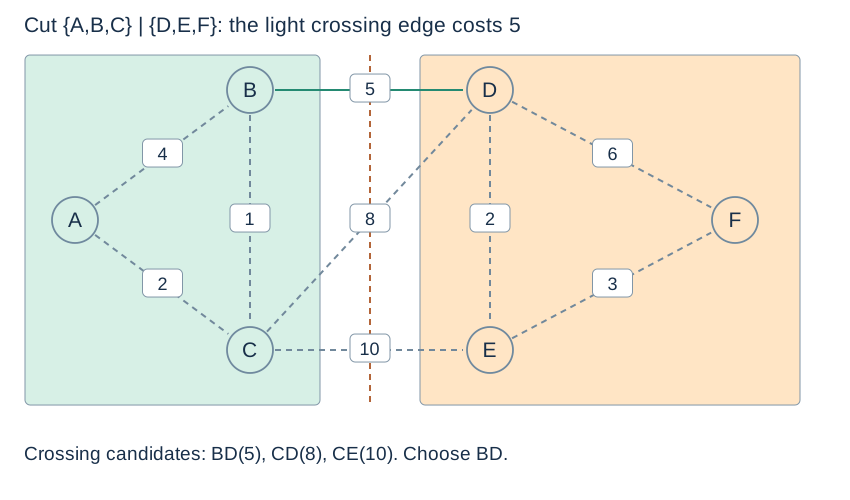
A cut divides the vertices into two nonempty groups. An edge crosses it when its endpoints are in different groups. Suppose the already accepted forest is contained in some optimum spanning tree, and no accepted edge crosses the cut. A minimum-weight crossing edge can be added while retaining the possibility of an optimum completion.
Exchange an edge without increasing total cost
If an optimum completion omits the light edge, add it. This creates a cycle, which must contain another edge crossing the same cut. Remove that other edge. Its weight is at least the chosen light edge’s weight, and it was not an earlier accepted edge because the cut respects the accepted forest. The result is another optimum completion including the new choice.
The condition about respecting accepted edges is important: an arbitrary greedy edge is not safe merely because it looks locally small. Prim and Kruskal maintain cuts for which the argument applies.
Ties and negative weights need precise claims
Equal weights can allow several optimum trees. A light crossing edge belongs to some optimum completion; it need not belong to every MST. If all edge weights are distinct, the MST is unique, but distinct weights are not necessary for uniqueness.
Negative weights are valid for MSTs: the selected edges form a finite acyclic structure, so there is no opportunity to repeat a negative cycle to reduce a route indefinitely. Another useful rule is the cycle property: a uniquely heaviest edge on a cycle cannot belong to any MST. If the maximum is tied, the stronger exclusion claim no longer follows.
Costs and implementation choices
A forest stores O(n+1) chosen edge records, but constructing it can require inspecting all m input edges. The cut/exchange argument is a correctness tool, not itself an implementation or an operation cost. Prim maintains crossing candidates in a heap; Kruskal sorts globally and checks components with union–find. Their work/storage bounds depend on those choices.
A minimum forest minimises construction cost subject to preserving each original component’s connectivity. It does not connect components when no input edge can do so, and it need not retain every vertex’s shortest route from a source. A disconnected forest may have no edges even when its vertex set is nonempty.
Check your understanding
Predict the result or state change before opening the explanation.
1. For seven vertices in three connected components, how many edges does a spanning forest contain?
Show explanation
Four: n−c = 7−3. Singleton components contribute a vertex but no chosen edge.
2. Does a negative edge invalidate an MST problem as it invalidates Dijkstra’s contract?
Show explanation
No. MSTs select an acyclic set of edges. They do not repeatedly traverse a negative cycle to reduce a route cost.
Next: Prim.