After this page, you should be able to:
Explain relaxation and distinguish tentative labels from final distances.
Specify complete distance/parent results and recover one consistent route.
Builds on: BFS distances and parents and weighted graph models.
Code languages: Python defines the explanations, figures and self-checks. Use the language guide for native conventions and dependencies. Complete runnable topic examples: Python · JavaScript · Julia.
These versions reuse the translated deque, heap and disjoint-set definitions. Julia Dict order can select a different valid topological order or tied forest; compare the objective, feasibility and optimum cost rather than requiring an identical printed edge order. Heap counters avoid comparing payloads.
Minimise the sum along a source-to-target route
A weighted shortest path minimises its edge-weight sum. It differs from BFS’s hop count: a direct edge of weight 10 can lose to two edges of weight 2. In a directed graph, every step must follow an outgoing edge.
The shared graph uses these outgoing lists. G remains an explicit isolated vertex.
weighted = {
    "A": [("B", 4), ("C", 1)],
    "B": [("D", 1), ("E", 7)],
    "C": [("B", 2), ("D", 5), ("F", 8)],
    "D": [("E", 3)], "E": [("F", 1)],
    "F": [], "G": [],
}
var weighted = new Map([
["A", [["B",4],["C",1]]], ["B", [["D",1],["E",7]]],
["C", [["B",2],["D",5],["F",8]]], ["D", [["E",3]]],
["E", [["F",1]]], ["F", []], ["G", []]
]);weighted = Dict("A"=>[("B",4),("C",1)], "B"=>[("D",1),("E",7)],
"C"=>[("B",2),("D",5),("F",8)], "D"=>[("E",3)], "E"=>[("F",1)],
"F"=>Tuple{String,Int}[], "G"=>Tuple{String,Int}[])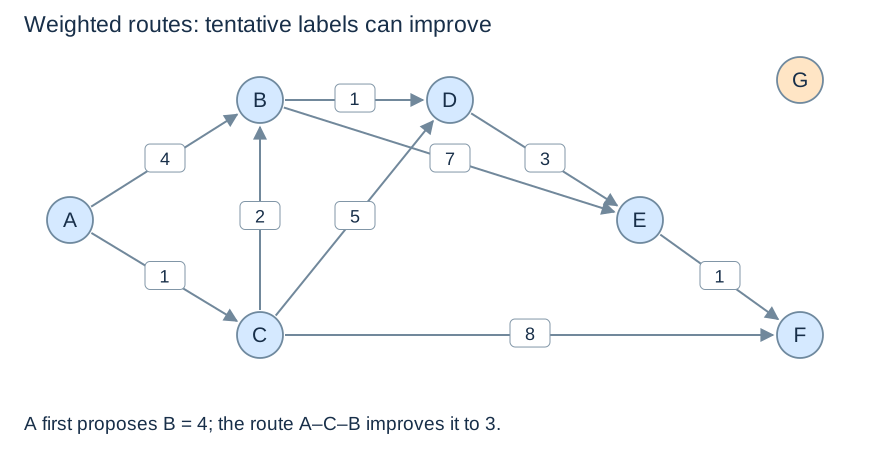
Separate an algorithm result from route recovery
The shortest-path functions return (distance, parent) dictionaries covering all graph keys. The source distance is 0, an unreachable distance is inf, and the source/unreachable parents are None. Each reachable non-source parent selects one route, not every tied shortest route. Source labels must exist; a missing source raises KeyError. The input graph is observed without mutation, and the dictionaries are snapshots.
Use finite numeric edge weights with consistent comparison/arithmetic and non-None hashable labels. These are preconditions unless a function explicitly checks them. Dijkstra additionally rejects negative edges; DAG relaxation permits negatives but rejects cycles. The graph’s weighted list entries are (destination, weight), not the (weight, u, v) edge-list format used by Kruskal.
A known route supplies a candidate improvement
Set the source distance to 0 and other distances to infinity. If a route to u has cost distance[u], following edge (u,v,w) gives candidate cost distance[u] + w. Relaxation updates v only when that candidate is strictly smaller than its current distance, and records u as its predecessor.
After A, B has tentative distance 4 and C has 1. Via C, B improves to 1 + 2 = 3; its predecessor becomes C. “First discovered” is therefore not the same as “final distance,” unlike BFS’s first discovery in an unweighted graph.
A distance label represents a route actually found
Every finite tentative distance is the cost of a discovered route, and is an upper bound on the optimum when a finite optimum exists. An algorithm needs an additional argument to establish finality. Dijkstra uses nonnegative weights; a DAG algorithm uses topological order.
A predecessor records one improving route. Equal candidates need not replace it. Strict improvement avoids unnecessary heap entries and avoids creating predecessor cycles merely by accepting equal-cost alternatives around zero-weight cycles.
Recover the route using results from the same run
from math import inf

def weighted_path_to(source, target, distance, parent):
    if distance[target] == inf:
        return None
    path = []
    current = target
    while current is not None:
        path.append(current)
        current = parent[current]
    path.reverse()
    return path
function weighted_path_to(source, target, distance, parent) {
if (!distance.has(target)) throw new KeyError(String(target));
if (distance.get(target) === Infinity) return null;
const path = []; let current = target;
while (current !== null) { path.push(current); current = parent.get(current); }
return path.reverse();
}function weighted_path_to(source, target, distance, parent)
distance[target] == Inf && return nothing
path = Any[]; current = target
while current !== nothing; push!(path, current); current = parent[current]; end
return reverse!(path)
endUse valid source and target keys, non-None vertex labels, and predecessor results from the same algorithm run. The source argument documents that association; this helper does not independently validate a supplied predecessor structure. The source returns a one-vertex path. An unreachable vertex has infinite distance and returns None, even though its predecessor and the source’s predecessor are both None.
For the shared graph, the eventual A-to-F route is A–C–B–D–E–F with cost 8; G stays unreachable. Recovering a k-edge route takes time and output storage.
Implementation choices, costs and limits
One relaxation uses O(1) time/workspace under constant-cost arithmetic and expected dictionary access. Initialising all distance/parent entries takes Θ(n+1) time and result storage. The processing order determines how many relaxations are needed and why the final labels are correct; the relaxation formula alone supplies neither a whole algorithm nor its total bound.
weighted_path_to uses O(k+1) time and returned space for a k-edge route, with O(1) local workspace. Unknown target keys raise KeyError; an unreachable valid target returns None. The helper assumes consistent dictionaries from the same run and does not detect malformed/cyclic parent data. Following parents is appropriate only after an algorithm has established the required result.
Equal-cost candidates do not replace parents in the shown algorithms. This gives one reproducible result for fixed iteration/heap tie order, without claiming uniqueness. Graph changes require another run. General negative-cycle problems remain an explicit extension, rather than something route recovery can fix.
Check your understanding
Predict the result or state change before opening the explanation.
1. A first gives B distance 4. C later offers a route of cost 3. Should B’s distance and parent change?
Show explanation
Yes. Strict improvement replaces the distance and records C as the improving predecessor.
2. Both the source and an unreachable G have parent None. How does route recovery distinguish them?
Show explanation
It checks distance first: the source has distance 0 and returns a one-vertex route; G has inf and returns None.
Next: Dijkstra.