After this page, you should be able to:
Compare structures using the same query and a consistent definition of work.
Choose a point or object index without mistaking candidate filtering for final geometry evaluation.
Builds on: Bring together point-based splits, midpoint cells and R-tree enclosures.
Ask what the boundaries mean
| Structure | Boundary or grouping rule | Stored objects in these readings | Main consequence |
|---|---|---|---|
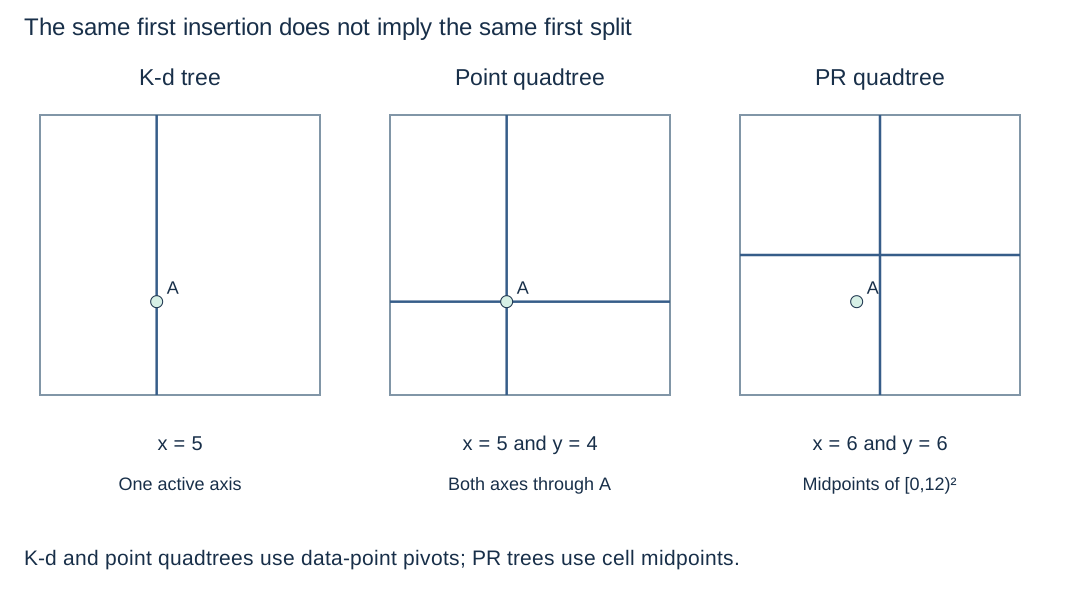
| Insertion-order k-d tree | One active-axis split through each point | Points at nodes | Binary shape depends on insertion order; axes alternate |
| Point quadtree | Both axes split through each point | Points at nodes | Four-way, data-dependent partitions; order can change the root and shape |
| Bucket PR quadtree | Fixed cell midpoints when occupancy requires subdivision | Points in leaves | Regular bounded cells; bucket/depth policy controls splitting |
| R-tree | Enclosing rectangles around object/child groups | Line records in the given example; also suitable for points or extended geometries | Groups may overlap; queries may follow several branches and need exact refinement |
Neither point-quadtree branching nor PR subdivision is an AVL rotation. Each spatial rule must preserve its own region or enclosing-bound invariant.
Compare identical answers without requiring identical visits
All three point indexes use the same seven coordinates, insertion order and closed rectangle [1,4] × [2,7]. Their answer set is {B,D,E}.
| Implementation | Relevant work on this query | Report order |
|---|---|---|
| K-d range code | 4 nonempty point nodes visited: A,B,D,E | B,D,E |
| Point-quadtree range code | 4 nonempty point nodes visited: A,D,B,E | D,B,E |
| PR-quadtree range code | 13 cell bounds examined; 9 cells accepted; 4 point records tested | D,B,E |
An explicit empty PR cell is not equivalent to an absent point-tree child. Therefore compare definitions of visits before interpreting the counts as a performance result. These are traces of one instance, not a universal ranking or benchmark. Every method must also emit all r reported records.
Choose using data, queries and updates
A scan is attractive for small or infrequently queried collections. K-d trees are a natural point-search example, including the nearest-neighbour traversal already developed here. PR quadtrees make regular region ownership and adaptive occupancy visible. Point quadtrees provide a close conceptual bridge from data-point splits, but may develop long paths. R-trees organise bounds of extended objects and are widely used in spatial indexing; query selectivity depends on grouping, overlap and geometry.
All four methods now cover construction/insertion, exact lookup, ranges, nearest search and deletion. The boundary invariants explain why their implementations differ:
| Method | Nearest pruning | Deletion strategy here | Persistent space |
|---|---|---|---|
| K-d tree | Active split-plane lower bound | Axis-minimum replacement, preserving depths | O(n) |
| Point quadtree | Distance to inherited cell | Collect and rebuild affected subtree | O(n) |
| PR quadtree | Distance to fixed midpoint cell | Remove from bucket; merge eligible siblings | O(n+I+1), I internal cells |
| R-tree | MBR lower bound plus exact segment distance | Conceptual CondenseTree and reinsertion | O(n+1), fixed fanout and valid occupancy |
See the complete cost tables for k-d trees, point quadtrees, PR quadtrees and R-trees. None promises distribution-independent logarithmic nearest search. For lines, a containing box provides a lower bound rather than exact object distance.
General R-tree updates and static packing remain conceptual; compressed spatial trees and approximate/high-dimensional nearest indexing are beyond this chapter.
Run the examples together
Download the standard-library spatial-search example, save it as spatial_search.py, and run python spatial_search.py. It includes k-d, point-quadtree and PR construction/exact/range/nearest/deletion operations, plus given-tree R-tree exact/range/nearest queries and exact segment refinement. No notebook, package installation or private course repository is required.
To execute these pages as listings, read them in order in one Python session: the spatial-query helpers, point quadtree, PR operations, then the new nearest/update companions, R-tree representation/query and R-tree operations. The downloadable script supplies the correct dependency order.
Check your understanding
Predict the answer before opening the explanation.
1. The PR query examines 13 node bounds while the k-d query visits 4 nonempty point nodes. Does that prove PR trees are always slower?
Show explanation
No. The counters measure different work. This PR representation includes explicit empty cells; it accepts nine cells and tests four point records. One small instance and different counting conventions cannot establish a universal performance ranking.
2. To find lines crossing a rectangle, could we index only line endpoints as points and return lines with an endpoint inside? Use L2 as a check.
Show explanation
That would miss valid crossings. L2 runs from (0,7) to (6,7); neither endpoint is inside [2,4] × [6,8], but the segment crosses it. Object bounds plus an exact segment predicate preserve that case; a point-endpoint query answers a different question.
Continue to priority queues and heaps, or return to the spatial-search overview, concept index or coverage review.