After this page, you should be able to:
Explain how a PR cell fixes split locations independently of stored pivots.
Separate bucket capacity, storage-boundary ownership and termination policies.
Builds on: Point quadtrees supply the four-way idea; PR trees change where cuts come from.
Follow the five operations
| Operation | Read here |
|---|---|
| Construction and insertion | Midpoint rules below, then bucket redistribution |
| Exact point lookup | contains in the implementation |
| Range search | Cell filtering and point tests |
| Nearest neighbour | Cell lower bounds and bucket distances |
| Deletion and costs | Remove, merge upwards and count work |
The cell determines where a split occurs
A point-region (PR) quadtree starts with a fixed bounded region. When a leaf bucket overflows, subdivide its cell into four equal quadrants. Internal nodes represent subdivision; point records live in leaves. Data determine whether subdivision is needed, but the cell bounds determine its location.
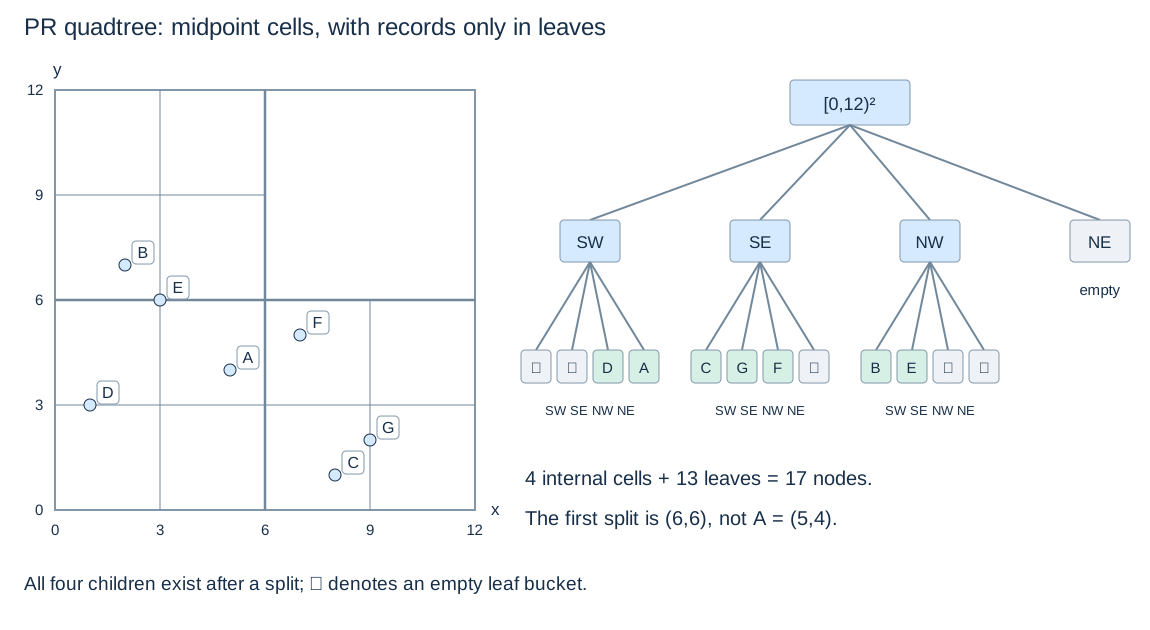
The shared example uses root extent [0,12) × [0,12) and bucket capacity one. Its first split is at (6,6), even though the first inserted point A is (5,4). A is stored in a leaf bucket; it is not promoted into an internal pivot.
Separate cell ownership from query inclusion
All storage cells are half-open: include their lower x/y boundaries and exclude their upper boundaries. At a midpoint, equal x goes east and equal y goes north. Four children partition a parent cell without duplicating stored points. Points on the root’s excluded maximum edges are outside the configured extent.
The range query is still closed, just like the k-d and point-quadtree queries. A point at query xmax can be a result while belonging to the eastern cell. These contracts describe different things and must not be conflated.
| Structure | What fixes a split? | Where are point records? |
|---|---|---|
| Point quadtree | A stored point’s x and y | At every occupied node |
| PR quadtree | The current cell’s midpoint | In leaf buckets |
Follow occupied cells rather than stored pivots
At the root, A and D belong to SW; C, F and G to SE; B and E to NW; NE is empty. Each occupied root child contains multiple points and splits once more at its own midpoint. In SW, the midpoint is (3,3); in SE it is (9,3); in NW it is (3,9). All seven points then occupy separate buckets.
The final capacity-one tree has four internal nodes, thirteen leaves and seventeen total nodes, including empty leaves. Inserting the same distinct points in another order produces the same final region partition for this capacity/depth policy. Bucket order can differ. This contrasts with the data-dependent point-quadtree shape.
A capacity threshold needs a termination policy
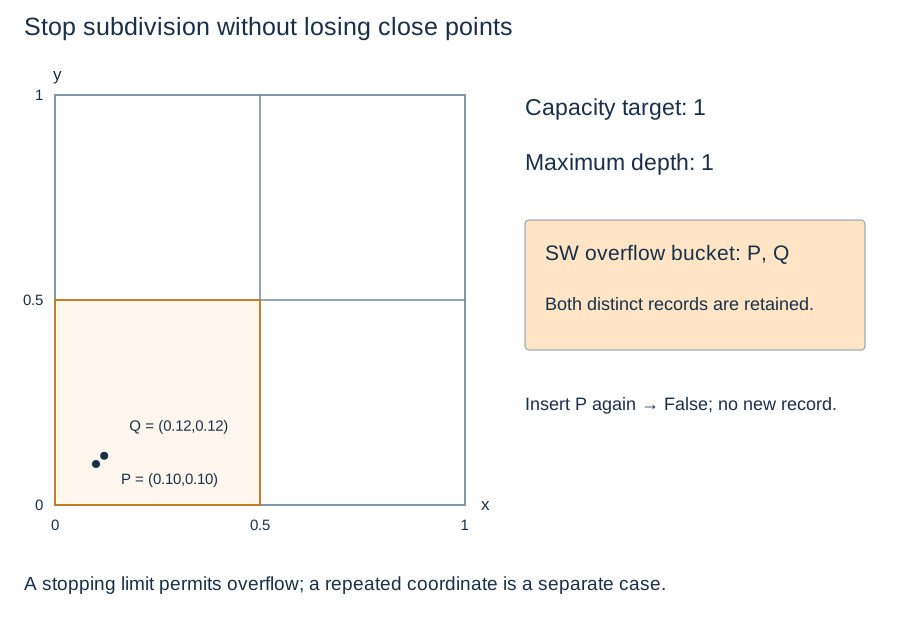
Repeated coordinates should not trigger endless subdivision. The implementation on the next page stores a point set, so a duplicate is rejected before splitting. A record-oriented version could keep multiple identifiers together at one coordinate.
Distinct points can also be extremely close. A maximum depth limits subdivision; floating-point midpoints must also lie strictly inside the cell to make progress. When a limit is reached, keep an overflow bucket rather than lose records or recurse forever. Capacity is therefore a splitting target, not an unconditional maximum leaf occupancy.
Keep region quadtrees distinct too
A region quadtree commonly subdivides raster/image regions until each leaf is homogeneous in value. It shares regular four-way subdivision but stores a different kind of information from a PR tree of point records. The word quadtree names a family, not one universal node contract.
OpenDSA’s PR-quadtree chapter introduces regular point-region subdivision and varying bucket thresholds. Our finite-depth implementation adds explicit stopping and half-open boundary policies.
Check your understanding
Predict the answer before opening the explanation.
1. With extent [0,12)² and capacity 1, what happens after inserting A=(5,4) alone? Then where do A and B=(2,7) go after B is inserted?
Show explanation
After A alone, the root is a leaf containing A; there are no child cells yet. B overflows that bucket, so the root splits at (6,6). A moves into SW and B into NW. Neither becomes an internal pivot.
2. At the root midpoint (6,6), which child owns (6,6)? Is (12,6) inside the root?
Show explanation
(6,6) belongs to NE because both ties go east/north. (12,6) is outside the half-open root extent. If (6,6) is inserted, a closed point-sized query (6,6,6,6) includes it; storage ownership does not make the query half-open.
Next: PR-quadtree operations.