After this page, you should be able to:
Follow redistribution from a leaf bucket into four children without losing or duplicating records.
Explain exact lookup and range reporting when empty cells or overflow buckets are present.
Builds on: Use the spatial-query helpers, quadrant function and PR storage rules.
Code languages: Python defines the explanations, figures and self-checks. Use the language guide for native conventions and dependencies. Complete runnable topic examples: Python · JavaScript · Julia.
JavaScript points are arrays compared by same_point; Julia points are value tuples. Julia coordinate/child indices are one-based (x=1, y=2; SW/SE/NW/NE=1/2/3/4), while depth still starts at zero. R-tree orientation uses exact big-integer arithmetic for the supplied integer-coordinate geometry; nearest distances remain floating calculations. General R-tree update code is still conceptual in every language.
Encode one ownership rule in shared helpers
These listings reuse checked_rect, in_closed_rect and shared_points from the spatial-query page. Points are finite numeric two-element tuples; exact duplicates are ignored. Child order remains SW, SE, NW, NE.
def in_half_open_cell(point, cell):
    x, y = point
    xmin, ymin, xmax, ymax = cell
    return xmin <= x < xmax and ymin <= y < ymax

def cell_query_overlap(cell, query):
    xmin, ymin, xmax, ymax = cell
    qxmin, qymin, qxmax, qymax = query
    return (qxmax >= xmin and qxmin < xmax
            and qymax >= ymin and qymin < ymax)

def midpoint_cells(cell):
    xmin, ymin, xmax, ymax = cell
    mx, my = xmin / 2 + xmax / 2, ymin / 2 + ymax / 2
    if not (xmin < mx < xmax and ymin < my < ymax):
        return None
    return ((xmin, ymin, mx, my), (mx, ymin, xmax, my),
            (xmin, my, mx, ymax), (mx, my, xmax, ymax))

class PRNode:
    def __init__(self, bounds):
        self.bounds = bounds
        self.points = []
        self.children = None
function in_half_open_cell([x,y],[xmin,ymin,xmax,ymax]) { return xmin<=x && x<xmax && ymin<=y && y<ymax; }
function cell_query_overlap([xmin,ymin,xmax,ymax],[a,b,c,d]) { return c>=xmin && a<xmax && d>=ymin && b<ymax; }
function midpoint_cells([xmin,ymin,xmax,ymax]) {
const mx=xmin/2+xmax/2, my=ymin/2+ymax/2;
if (!(xmin<mx && mx<xmax && ymin<my && my<ymax)) return null;
return [[xmin,ymin,mx,my],[mx,ymin,xmax,my],[xmin,my,mx,ymax],[mx,my,xmax,ymax]];
}
class PRNode {
constructor(bounds) { this.bounds=bounds; this.points=[]; this.children=null; }
}function in_half_open_cell(point,cell)
x,y=point; xmin,ymin,xmax,ymax=cell
return xmin<=x<xmax && ymin<=y<ymax
end
function cell_query_overlap(cell,query)
xmin,ymin,xmax,ymax=cell; a,b,c,d=query
return c>=xmin && a<xmax && d>=ymin && b<ymax
end
function midpoint_cells(cell)
xmin,ymin,xmax,ymax=cell; mx=xmin/2+xmax/2; my=ymin/2+ymax/2
(xmin<mx<xmax && ymin<my<ymax) || return nothing
return ((xmin,ymin,mx,my),(mx,ymin,xmax,my),(xmin,my,mx,ymax),(mx,my,xmax,ymax))
end
mutable struct PRNode
bounds
points::Vector{Any}
children
end
PRNode(bounds)=PRNode(bounds,Any[],nothing)The overlap test is intentionally asymmetric: a query whose minimum equals the cell’s excluded maximum cannot find a point in that cell. A query whose maximum equals the cell’s included minimum can. Midpoint calculation avoids summing two large same-sign endpoints before halving; the strict interior test also detects numerical failure to shrink a cell.
Redistribute records when a leaf becomes internal
class PRQuadTree:
    def __init__(self, bounds, capacity=1, max_depth=16):
        bounds = checked_rect(bounds)
        if bounds[0] == bounds[2] or bounds[1] == bounds[3]:
            raise ValueError("root extent must have positive width and height")
        if type(capacity) is not int or capacity < 1:
            raise ValueError("capacity must be a positive integer")
        if type(max_depth) is not int or max_depth < 0:
            raise ValueError("max_depth must be a nonnegative integer")
        self.root = PRNode(bounds)
        self.capacity = capacity
        self.max_depth = max_depth
        self.members = set()

    def insert(self, point):
        if not in_half_open_cell(point, self.root.bounds):
            raise ValueError("point lies outside the configured extent")
        if point in self.members:
            return False
        pending = [(self.root, point, 0)]
        while pending:
            node, p, depth = pending.pop()
            if node.children is not None:
                cells = node.children
                pivot = (cells[0].bounds[2], cells[0].bounds[3])
                index = point_quadrant(p, pivot)
                pending.append((cells[index], p, depth + 1))
                continue
            subdivisions = midpoint_cells(node.bounds)
            if (len(node.points) < self.capacity
                    or depth >= self.max_depth or subdivisions is None):
                node.points.append(p)
                continue
            records = node.points + [p]
            node.points = []
            node.children = [PRNode(cell) for cell in subdivisions]
            pivot = (subdivisions[0][2], subdivisions[0][3])
            for old in records:
                index = point_quadrant(old, pivot)
                pending.append((node.children[index], old, depth + 1))
        self.members.add(point)
        return True

    def contains(self, point):
        if not in_half_open_cell(point, self.root.bounds):
            return False
        node = self.root
        while node.children is not None:
            pivot = (node.children[0].bounds[2], node.children[0].bounds[3])
            node = node.children[point_quadrant(point, pivot)]
        return point in node.points

    def range_query(self, rect):
        rect = checked_rect(rect)
        out, stack = [], [self.root]
        while stack:
            node = stack.pop()
            if not cell_query_overlap(node.bounds, rect):
                continue
            if node.children is None:
                out.extend(p for p in node.points if in_closed_rect(p, rect))
            else:
                stack.extend(reversed(node.children))
        return out

pr_tree = PRQuadTree((0, 0, 12, 12), capacity=1)
for point in shared_points:
    pr_tree.insert(point)
class PRQuadTree {
constructor(bounds,capacity=1,max_depth=16) {
bounds=checked_rect(bounds);
if (bounds[0]===bounds[2] || bounds[1]===bounds[3]) throw new RangeError("positive extent required");
if (!Number.isSafeInteger(capacity)||capacity<1||!Number.isSafeInteger(max_depth)||max_depth<0)
throw new RangeError("invalid capacity/depth");
this.root=new PRNode(bounds); this.capacity=capacity; this.max_depth=max_depth; this.members=new Set();
}
insert(point) {
if (!in_half_open_cell(point,this.root.bounds)) throw new RangeError("point outside extent");
const key=JSON.stringify(point); if (this.members.has(key)) return false;
const pending=[[this.root,point,0]];
while (pending.length) {
const [node,p,depth]=pending.pop();
if (node.children!==null) {
const pivot=[node.children[0].bounds[2],node.children[0].bounds[3]];
pending.push([node.children[point_quadrant(p,pivot)],p,depth+1]); continue;
}
const subdivisions=midpoint_cells(node.bounds);
if (node.points.length<this.capacity || depth>=this.max_depth || subdivisions===null) { node.points.push(p); continue; }
const records=[...node.points,p]; node.points=[]; node.children=subdivisions.map(c=>new PRNode(c));
const pivot=[subdivisions[0][2],subdivisions[0][3]];
for (const old of records) pending.push([node.children[point_quadrant(old,pivot)],old,depth+1]);
}
this.members.add(key); return true;
}
contains(point) {
if (!in_half_open_cell(point,this.root.bounds)) return false;
let node=this.root;
while (node.children!==null) {
const pivot=[node.children[0].bounds[2],node.children[0].bounds[3]];
node=node.children[point_quadrant(point,pivot)];
}
return node.points.some(p=>same_point(p,point));
}
range_query(rect) {
rect=checked_rect(rect); const out=[],stack=[this.root];
while (stack.length) {
const node=stack.pop(); if (!cell_query_overlap(node.bounds,rect)) continue;
if (node.children===null) for (const p of node.points) { if(in_closed_rect(p,rect))out.push(p); }
else stack.push(...node.children.slice().reverse());
}
return out;
}
}
var pr_tree=new PRQuadTree([0,0,12,12],1);
for (const point of shared_points) pr_tree.insert(point);mutable struct PRQuadTree
root::PRNode
capacity::Int
max_depth::Int
members::Set{Any}
end
function PRQuadTree(bounds,capacity=1,max_depth=16)
bounds=checked_rect(bounds)
(bounds[1]<bounds[3] && bounds[2]<bounds[4]) || throw(ArgumentError("positive extent required"))
(capacity isa Int && capacity>=1 && max_depth isa Int && max_depth>=0) || throw(ArgumentError("invalid capacity/depth"))
return PRQuadTree(PRNode(bounds),capacity,max_depth,Set{Any}())
end
function pr_insert!(tree::PRQuadTree,point)
in_half_open_cell(point,tree.root.bounds) || throw(ArgumentError("point outside extent"))
point in tree.members && return false
pending=Any[(tree.root,point,0)]
while !isempty(pending)
node,p,depth=pop!(pending)
if node.children!==nothing
pivot=(node.children[1].bounds[3],node.children[1].bounds[4])
push!(pending,(node.children[point_quadrant(p,pivot)],p,depth+1)); continue
end
subdivisions=midpoint_cells(node.bounds)
if length(node.points)<tree.capacity || depth>=tree.max_depth || subdivisions===nothing
push!(node.points,p); continue
end
records=copy(node.points); push!(records,p); node.points=Any[]
node.children=[PRNode(cell) for cell in subdivisions]
pivot=(subdivisions[1][3],subdivisions[1][4])
for old in records; push!(pending,(node.children[point_quadrant(old,pivot)],old,depth+1)); end
end
push!(tree.members,point); return true
end
function pr_contains(tree::PRQuadTree,point)
in_half_open_cell(point,tree.root.bounds) || return false
node=tree.root
while node.children!==nothing
pivot=(node.children[1].bounds[3],node.children[1].bounds[4])
node=node.children[point_quadrant(point,pivot)]
end
return point in node.points
end
function pr_range(tree::PRQuadTree,rect)
rect=checked_rect(rect); out=Any[]; stack=Any[tree.root]
while !isempty(stack)
node=pop!(stack); cell_query_overlap(node.bounds,rect) || continue
if node.children===nothing
append!(out,(p for p in node.points if in_closed_rect(p,rect)))
else; append!(stack,reverse(node.children)); end
end
return out
end
pr_tree=PRQuadTree((0,0,12,12),1)
for point in shared_points; pr_insert!(pr_tree,point); endpoint_quadrant comes from the preceding point-quadtree page. Every successful insertion increases the point set by one. Splitting moves the old bucket records into children and clears the internal bucket, preserving each stored point exactly once. The members set prevents duplicate insertion; contains deliberately demonstrates the spatial path and terminal bucket test rather than merely consulting that set. Clients must preserve these internal structures.
Query cells conservatively, then test bucket points exactly
pr_tree.range_query(shared_query) reports D, B and E. The root’s eastern cells cannot contribute because their x starts at 6. Its two western children can contribute, so descend into both. An intersecting leaf cell can still hold an outside point: A’s leaf cell meets the query, but A=(5,4) fails the exact point test.
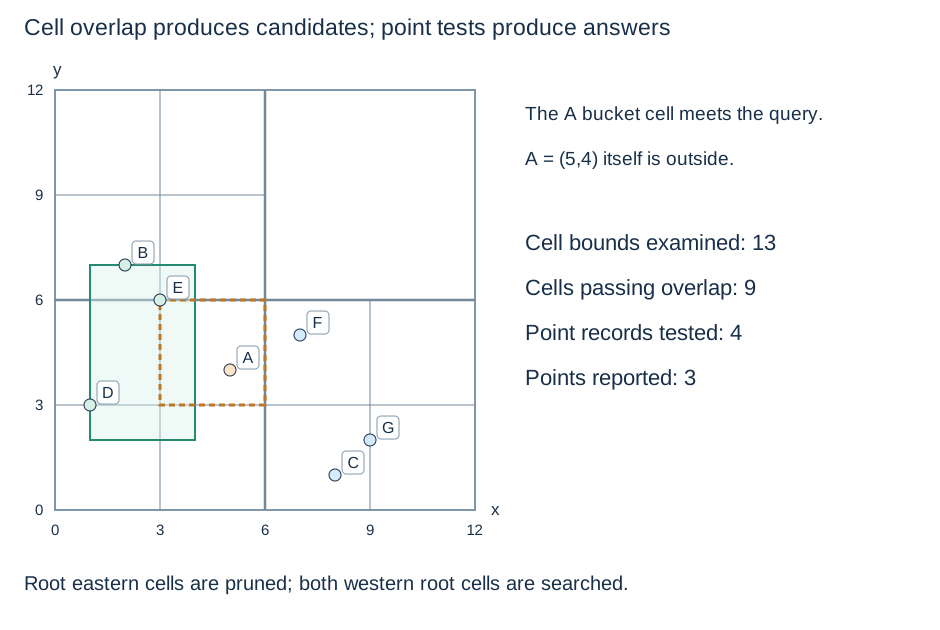
This stack pushes all four children of an internal node and rejects disjoint ones when popped. Thus a trace should distinguish examined cell bounds, accepted cells and tested point records. It examines thirteen node bounds, accepts nine cells and tests four point records for this shared query. Empty accepted leaves still incur a cell test.
Depth, bucket occupancy and subdivision all matter
For height H and terminal bucket occupancy k, lookup costs with constant working space. An overflow bucket can contain many records, so bounded depth does not guarantee a constant-size scan. A range query costs for V examined nodes and P point records tested, plus its output; P can be n in the worst case. A four-way depth-first stack needs working storage, plus results.
For bucket target b and s new splits during one insertion, redistribution work is , in addition to an existing descent of at most . A splitting bucket has b old records; an overflow bucket at a stopping limit simply appends. Duplicate-set operations are expected constant-time and bucket append is amortised constant-time. The pending redistribution stack has a conservative upper bound.
With n distinct points and I internal nodes, the explicit four-child representation has 4I+1 total nodes and persistent storage, including the duplicate set. Maximum depth bounds paths, not occupied buckets; empty children still use memory. Continue with the complete nearest and deletion/merge functions, including their costs.
Check your understanding
Predict the answer before opening the explanation.
1. What does the shared PR tree return for the closed query (3,6,3,6)? Which boundary rule keeps that point in exactly one storage cell?
Show explanation
Only E=(3,6). Its leaf is [3,6) × [6,9), whose lower boundaries are included. A western cell ending at x=3 and a southern cell ending at y=6 exclude those maximum edges. The closed query still includes its one coordinate.
2. Create a tree over [0,1)² with capacity 1 and max_depth=0. Insert (0.10,0.10) and (0.12,0.12), then insert the first point again. Predict the bucket and return values.
Show explanation
The first two insertions return True and both points remain in the root overflow bucket; depth zero forbids subdivision. The third insertion returns False because the duplicate set already contains that tuple. No record is discarded merely to satisfy capacity.