After this page, you should be able to:
Specify insertion, complete lookup, path queries, deletion and size/empty observers.
Trace terminal flags and safe suffix pruning without losing other keys.
Builds on: TrieNode and prefix invariants, state contracts and hash-table assumptions.
Code languages: Python defines the explanations, figures and self-checks. Use the language guide for native conventions and dependencies. Complete runnable topic examples: Python · JavaScript · Julia.
All matching positions count Unicode code points. JavaScript and Julia collect characters into arrays for constant-time access, adding O(n+m) preparation and storage to text/pattern scans; this is additional to the Python bounds. Julia results are one-based character-array positions, not byte indices into a Julia String. Rolling hashes use BigInt arithmetic explicitly; JavaScript custom base/modulus arguments are BigInts (for example 3n).
State duplicates, empty keys and return values
The following class reuses TrieNode from the previous page. insert returns whether a new key was added; delete returns whether a stored key was removed. Repeated insertion does not increase size. contains checks a complete key; has_prefix checks whether its path exists.
All query arguments must be strings. The empty prefix has a path even in an empty trie, so has_prefix("") returns True. The empty key is stored only when the root is terminal. Clients should use these operations rather than editing nodes or size directly.
Read the public string-set interface
Run the preceding TrieNode definition before this class. The root is retained even when no keys are stored.
| Operation | Result / logical change | Missing or empty case |
|---|---|---|
insert(word) | True for a new key; False for an existing key | "" marks the root terminal; duplicates leave key count unchanged |
contains(word) | Boolean complete-key membership | A path alone is insufficient |
has_prefix(prefix) | Boolean path existence | "" is always a path, even in an empty trie |
delete(word) | True if removed; False if not stored | Missing keys leave state unchanged; deleting "" clears only root terminal status |
len(trie) / trie.size | Number of stored complete keys | Empty key, when stored, counts as one |
is_empty() | Whether zero keys are stored | Existing root/path objects do not count as stored keys |
All word/prefix arguments must be strings; the class raises TypeError for other arguments before changing state. insert and delete deliberately report a boolean state change rather than using the None returns of some earlier Set adapters. Those are different documented interfaces. The size field is retained for existing clients; prefer len(trie) for observation, and do not edit this metadata or nodes directly.
Walk, mark, and prune only unused suffixes
class Trie:
    def __init__(self):
        self.root = TrieNode()
        self.size = 0

    def __len__(self):
        return self.size

    def is_empty(self):
        return self.size == 0

    def _walk(self, text):
        if not isinstance(text, str):
            raise TypeError("expected a string")
        node = self.root
        for char in text:
            node = node.children.get(char)
            if node is None:
                return None
        return node

    def contains(self, word):
        node = self._walk(word)
        return node is not None and node.terminal

    def has_prefix(self, prefix):
        return self._walk(prefix) is not None

    def insert(self, word):
        if not isinstance(word, str):
            raise TypeError("expected a string")
        node = self.root
        for char in word:
            if char not in node.children:
                node.children[char] = TrieNode()
            node = node.children[char]
        if node.terminal:
            return False
        node.terminal = True
        self.size += 1
        return True

    def delete(self, word):
        if not isinstance(word, str):
            raise TypeError("expected a string")
        node = self.root
        path = []
        for char in word:
            child = node.children.get(char)
            if child is None:
                return False
            path.append((node, char, child))
            node = child
        if not node.terminal:
            return False
        node.terminal = False
        self.size -= 1
        for parent, char, child in reversed(path):
            if child.terminal or child.children:
                break
            del parent.children[char]
        return True
class Trie {
constructor() { this.root = new TrieNode(); this.size = 0; }
is_empty() { return this.size === 0; }
_walk(text) {
if (typeof text !== "string") throw new TypeError("expected a string");
let node = this.root;
for (const char of text) { node = node.children.get(char); if (node === undefined) return null; }
return node;
}
contains(word) { const node = this._walk(word); return node !== null && node.terminal; }
has_prefix(prefix) { return this._walk(prefix) !== null; }
insert(word) {
if (typeof word !== "string") throw new TypeError("expected a string");
let node = this.root;
for (const char of word) {
if (!node.children.has(char)) node.children.set(char, new TrieNode());
node = node.children.get(char);
}
if (node.terminal) return false;
node.terminal = true; this.size++; return true;
}
delete(word) {
if (typeof word !== "string") throw new TypeError("expected a string");
let node = this.root; const path = [];
for (const char of word) {
const child = node.children.get(char); if (child === undefined) return false;
path.push([node,char,child]); node = child;
}
if (!node.terminal) return false;
node.terminal = false; this.size--;
for (let i = path.length - 1; i >= 0; i--) {
const [parent,char,child] = path[i];
if (child.terminal || child.children.size) break;
parent.children.delete(char);
}
return true;
}
}mutable struct Trie
root::TrieNode
n::Int
end
Trie() = Trie(TrieNode(), 0)
Base.length(t::Trie) = t.n
Base.isempty(t::Trie) = t.n == 0
function trie_walk(t::Trie, text)
text isa AbstractString || throw(ArgumentError("expected a string"))
node = t.root
for char in text
node = get(node.children, char, nothing)
node === nothing && return nothing
end
return node
end
function trie_contains(t::Trie, word)
node = trie_walk(t, word); return node !== nothing && node.terminal
end
has_prefix(t::Trie, prefix) = trie_walk(t, prefix) !== nothing
function trie_insert!(t::Trie, word)
word isa AbstractString || throw(ArgumentError("expected a string"))
node = t.root
for char in word
if !haskey(node.children, char); node.children[char] = TrieNode(); end
node = node.children[char]
end
node.terminal && return false
node.terminal = true; t.n += 1; return true
end
function trie_delete!(t::Trie, word)
word isa AbstractString || throw(ArgumentError("expected a string"))
node = t.root; path = Any[]
for char in word
child = get(node.children, char, nothing); child === nothing && return false
push!(path, (node,char,child)); node = child
end
!node.terminal && return false
node.terminal = false; t.n -= 1
for (parent,char,child) in Iterators.reverse(path)
(child.terminal || !isempty(child.children)) && break
delete!(parent.children, char)
end
return true
endBuild the shared example once, in this order, for the prefix-query traces on the next page:
trie = Trie()
for word in ["be", "bus", "buses", "busy", "car"]:
    trie.insert(word)
var trie = new Trie();
for (const word of ["be","bus","buses","busy","car"]) trie.insert(word);trie = Trie()
for word in ["be","bus","buses","busy","car"]; trie_insert!(trie, word); endDeleting a key must preserve other keys’ prefixes
After unmarking the target, a nonterminal child with no descendants is unused and can be removed. Repeat upwards until a terminal node or a node with another child is reached. A missing key changes nothing.
Deleting "bus" only clears its flag because its descendants still store "buses" and "busy". Starting from the original shared set, deleting "buses" removes its final s and then e, but stops at the terminal, branching "bus" node. Those are two separate scenarios, not cumulative updates.
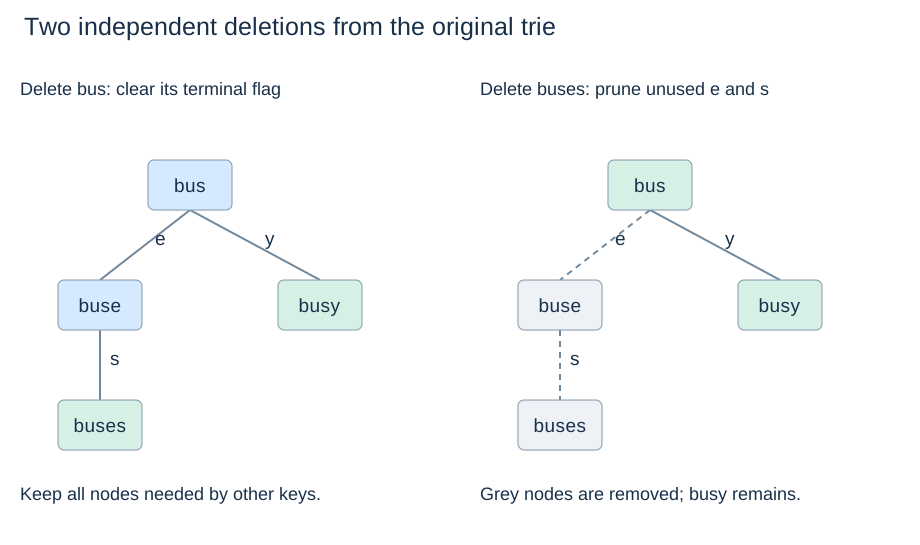
Insertion preserves the invariant by adding only missing prefix nodes and marking exactly the final node. Deletion preserves every other key because it removes only nodes that neither terminate a key nor lead to one.
Separate traversal space from new stored nodes
For a key of length L, lookup, insertion and deletion take expected time under the dictionary model. Lookup and insertion use constant auxiliary working space; insertion can allocate up to L new persistent nodes. Deletion stores up to L path entries, using auxiliary space. All loops are iterative, so a long key does not consume a recursive Python call per symbol.
size counts complete stored keys, not nodes. It is available in constant time. Turning this set into a map would require stored values at terminal nodes and a policy distinguishing absence from a legitimate value such as None.
Costs and public observations
The key-walk, persistent-node and deletion-path bounds above apply unchanged. The added len(trie) and is_empty() observers read the cached complete-key count in O(1) time and O(1) working space; they do not traverse the nodes. The retained trie.size field reports the same count.
A false-valued mutation result reports that no complete key was added/removed; it does not report that no relevant prefix path exists. The iterative loops handle long keys without one Python recursive frame per symbol. A map extension would require stored payloads and their replacement/absence rules; this class remains a string set.
Check your understanding
Predict the result or justify the choice before opening the explanation.
1. After inserting bus and buses, delete bus. What are contains(“bus”), has_prefix(“bus”) and len(trie)?
Show explanation
False, True and 1. The terminal marker is cleared, but the path remains for buses.
2. In an empty trie, what are has_prefix(“”), contains(“”) and is_empty()?
Show explanation
True, False and True. The empty path exists; the empty key is not stored until the root is marked terminal.
Next: Prefix queries.