After this page, you should be able to:
Read prefix paths, sparse child maps and terminal markers as separate information.
Explain root/empty-key behaviour and key-length/node-storage costs.
Builds on: String contracts, tree terminology and dictionary models.
Code languages: Python defines the explanations, figures and self-checks. Use the language guide for native conventions and dependencies. Complete runnable topic examples: Python · JavaScript · Julia.
All matching positions count Unicode code points. JavaScript and Julia collect characters into arrays for constant-time access, adding O(n+m) preparation and storage to text/pattern scans; this is additional to the Python bounds. Julia results are one-based character-array positions, not byte indices into a Julia String. Rolling hashes use BigInt arithmetic explicitly; JavaScript custom base/modulus arguments are BigInts (for example 3n).
A node represents the path from the root
A trie stores keys by successive symbols. The root represents the empty prefix. Following an edge labelled b, then u, then s reaches the prefix "bus". Keys with a common prefix share that path instead of repeating it in separate root-to-key comparisons.
Our shared set is {"be", "bus", "buses", "busy", "car"}. Nodes do not store whole prefixes; the path and edge labels determine them.
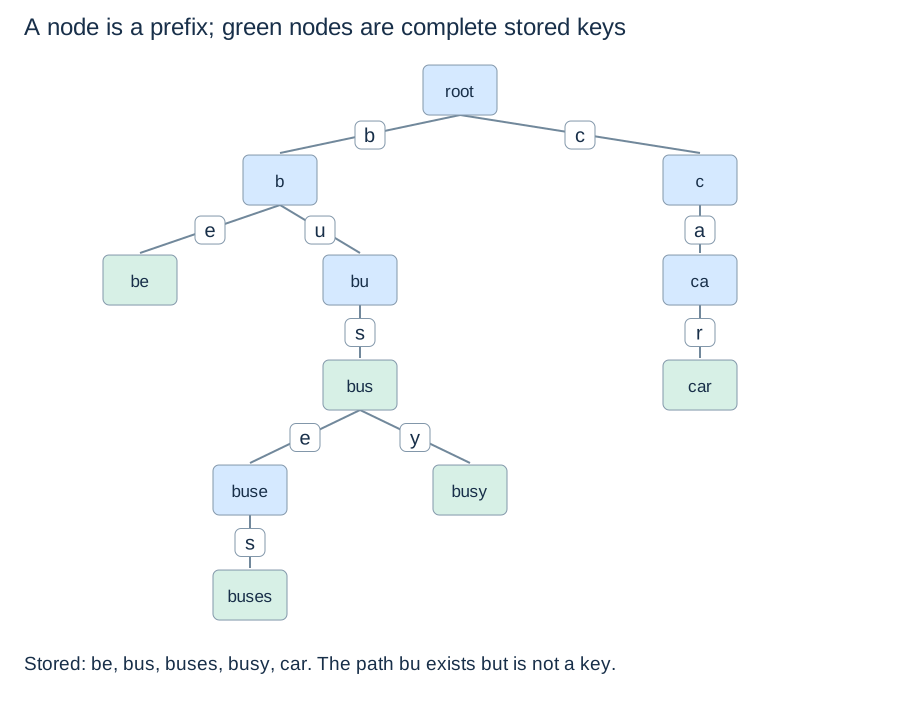
A complete key can also have descendants
The node for "bus" is terminal and has children because "buses" and "busy" are stored too. Conversely, the node for "bu" exists but is not terminal. Reaching it proves a prefix path exists, not that "bu" is stored.
A leaf test cannot replace the terminal flag. Terminal flags also let the root store the empty key without inventing a special edge symbol that might collide with real input.
Store only the outgoing symbols that exist
class TrieNode:
    def __init__(self):
        self.children = {}
        self.terminal = False
class TrieNode {
constructor() { this.children = new Map(); this.terminal = false; }
}mutable struct TrieNode
children::Dict{Char,Any}
terminal::Bool
end
TrieNode() = TrieNode(Dict{Char,Any}(), false)Every child dictionary maps a one-code-point string to one node. Each node has at most one outgoing edge for a given symbol. Different incoming symbols lead to different nodes: this representation is a tree, not a graph that merges equal suffixes.
A fixed alphabet could use one array slot per symbol, trading direct access for empty slots. A dictionary stores sparse children and accommodates the Unicode symbols encountered. We use expected constant-time child lookup under the same hash-table assumptions as Topic 6; this is not an unconditional worst-case dictionary guarantee.
Shared paths reduce nodes but do not erase overhead
Let S be the sum of lengths of all distinct stored keys. There is one node per distinct nonempty prefix, plus the root, so at most S+1 nodes. Space is in the node/reference model. Even an empty trie has a root. Many Python objects and small dictionaries can still consume substantial memory.
This shape depends on symbols, not on balance rotations or numerical key intervals. A long single key creates a long path. Trie lookup depends on key length rather than a logarithmic height guarantee in the number of stored keys.
Invariants, construction and representation choices
Every node describes one root-to-node prefix, each outgoing symbol names at most one child, and terminal status records whether that prefix is a complete stored key. Node construction creates a fresh empty child dictionary and a nonterminal flag; it does not insert a key. Trie owns the root and maintains complete-key count separately.
If S is the sum of distinct key lengths, there are at most S+1 nodes, including the permanent root. With sparse expected dictionary access, one key walk takes O(L+1) time; space depends on stored prefixes rather than a logarithmic balance guarantee. A fixed-alphabet child array has different occupancy costs, and compressed/radix representations can reduce unary chains but need different edge-walk code.
Use the trie when prefix structure is relevant. A dictionary may be simpler for exact whole-key queries alone. Neither trie paths nor code-point ordering supplies locale-aware collation or relevance ranking.
Check your understanding
Predict the result or justify the choice before opening the explanation.
1. If bus and buses are stored, must the bus node be a leaf?
Show explanation
No. It is terminal and has descendants. Removing leaf-only assumptions is essential for keys that prefix other keys.
2. Does an empty trie have zero nodes?
Show explanation
No. It has a root, but zero stored keys until a terminal marker is set. Root existence and empty-key membership are different facts.
Next: Trie operations.