After this page, you should be able to:
Trace prefix-subtree enumeration and restoration of suspended iterator/path state.
Distinguish path existence, complete prefixes, lazy errors and output-sensitive costs.
Builds on: The complete Trie class and iterative DFS frames.
Code languages: Python defines the explanations, figures and self-checks. Use the language guide for native conventions and dependencies. Complete runnable topic examples: Python · JavaScript · Julia.
All matching positions count Unicode code points. JavaScript and Julia collect characters into arrays for constant-time access, adding O(n+m) preparation and storage to text/pattern scans; this is additional to the Python bounds. Julia results are one-based character-array positions, not byte indices into a Julia String. Rolling hashes use BigInt arithmetic explicitly; JavaScript custom base/modulus arguments are BigInts (for example 3n).
Descend to a prefix, then report its terminal descendants
A prefix lookup first follows one path. Reporting completions must then visit the matching subtree; finding the prefix does not make every answer free. This generator reuses the preceding Trie class.
def words_with_prefix(trie, prefix):
    node = trie._walk(prefix)
    if node is None:
        return
    path = list(prefix)
    if node.terminal:
        yield prefix
    stack = [(node, iter(node.children.items()))]
    while stack:
        try:
            char, child = next(stack[-1][1])
        except StopIteration:
            stack.pop()
            if stack:
                path.pop()
            continue
        path.append(char)
        if child.terminal:
            yield "".join(path)
        stack.append((child, iter(child.children.items())))
function* words_with_prefix(trie, prefix) {
const node = trie._walk(prefix); if (node === null) return;
const path = [...prefix]; if (node.terminal) yield prefix;
const stack = [[node, node.children.entries()]];
while (stack.length) {
const step = stack.at(-1)[1].next();
if (step.done) { stack.pop(); if (stack.length) path.pop(); continue; }
const [char,child] = step.value; path.push(char);
if (child.terminal) yield path.join("");
stack.push([child,child.children.entries()]);
}
}struct PrefixWords
trie::Trie
prefix
end
Base.IteratorSize(::Type{PrefixWords}) = Base.SizeUnknown()
Base.eltype(::Type{PrefixWords}) = String
words_with_prefix(t::Trie, prefix) = PrefixWords(t, prefix)
function Base.iterate(w::PrefixWords)
node = trie_walk(w.trie, w.prefix) # validation is delayed until iteration
node === nothing && return nothing
state = (path=collect(w.prefix), stack=Any[(node,iterate(node.children))])
node.terminal && return (String(w.prefix), state)
return iterate(w, state)
end
function Base.iterate(w::PrefixWords, state)
while !isempty(state.stack)
node, step = state.stack[end]
if step === nothing
pop!(state.stack)
!isempty(state.stack) && pop!(state.path)
continue
end
(char,child), next_state = step
state.stack[end] = (node,iterate(node.children,next_state))
push!(state.path, char)
push!(state.stack, (child,iterate(child.children)))
child.terminal && return (join(state.path), state)
end
return nothing
endFor the shared keys inserted in the order on the preceding page, list(words_with_prefix(trie, "bu")) gives ["bus", "buses", "busy"]. Prefix "bus" includes "bus" itself because its node is terminal. Missing prefixes yield nothing. Prefix "" enumerates every stored key, including the empty key if present.
Specify generators, missing results and order
words_with_prefix(trie, prefix) returns a generator, not a list. Use it with the preceding Trie/TrieNode definitions; it relies on their node invariant and _walk helper. Advancing it yields each matching stored key once, including the prefix itself when terminal. A missing path yields nothing. Empty prefix enumerates every key, while an empty trie yields no keys even though has_prefix("") is true.
longest_stored_prefix(trie, text) returns the longest complete stored prefix as a string, or None. If the empty key is stored, "" may be a successful result. Both query arguments must be strings (TypeError otherwise). Generator validation is delayed until advancement; longest-prefix validation is immediate. Neither query mutates the trie.
Child insertion order determines the generator’s depth-first output, not alphabetical or ranked order. Yielded strings are independent of the temporary path list. Do not mutate the index while a generator is being consumed; this is live traversal, not a snapshot of all keys at generator creation.
Restore the path when a suspended frame completes
The list path spells the node at the top of the DFS stack. Each frame retains its child iterator, like iterative DFS’s suspended frames. Entering a child appends its symbol; finishing that child pops the symbol. Joined strings are independent outputs, so later path changes do not alter earlier results.
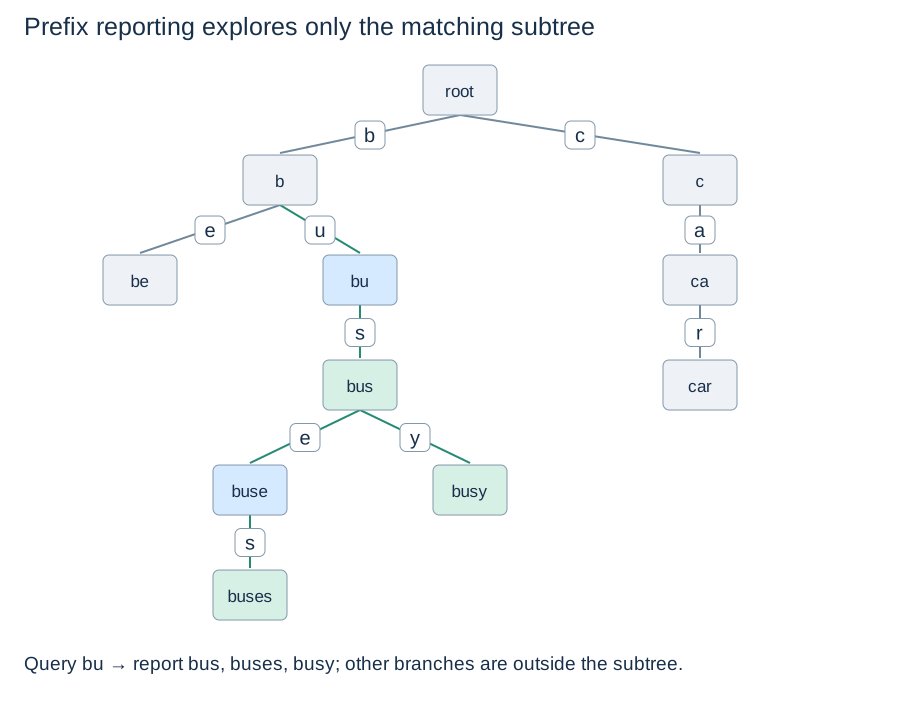
Dictionary insertion order determines traversal order; it is not a promise of alphabetical or relevance order. Sorting all results adds comparison work and storage. A ranked autocomplete service additionally needs scores and a top-k policy; this generator supplies prefix reporting only. Do not mutate the trie during iteration. Because this is a generator, traversal and argument validation occur when it is advanced.
Charge for visited nodes and emitted symbols
For prefix length L, V visited nodes in the selected subtree, and Z code points across the emitted strings, a full enumeration takes expected time. Joining each result costs its full length, including the shared prefix. The generator’s working state is , where H is the maximum depth below the query node; it does not push every child at once. Collecting results into a list additionally stores the result references and their characters. A failed prefix lookup costs at most .
Remember the deepest terminal node, not just the deepest path
def longest_stored_prefix(trie, text):
    if not isinstance(text, str):
        raise TypeError("expected a string")
    node = trie.root
    best = 0 if node.terminal else None
    for i, char in enumerate(text):
        node = node.children.get(char)
        if node is None:
            break
        if node.terminal:
            best = i + 1
    return None if best is None else text[:best]
function longest_stored_prefix(trie, text) {
if (typeof text !== "string") throw new TypeError("expected a string");
const chars = [...text]; let node = trie.root, best = node.terminal ? 0 : null;
for (let i = 0; i < chars.length; i++) {
node = node.children.get(chars[i]); if (node === undefined) break;
if (node.terminal) best = i + 1;
}
return best === null ? null : chars.slice(0,best).join("");
}function longest_stored_prefix(trie::Trie, text)
text isa AbstractString || throw(ArgumentError("expected a string"))
chars = collect(text); node = trie.root; best = node.terminal ? 0 : nothing
for (i,char) in enumerate(chars)
node = get(node.children, char, nothing); node === nothing && break
node.terminal && (best = i)
end
return best === nothing ? nothing : join(chars[1:best])
end"buseshed" returns "buses"; "bustop" returns "bus"; "buoyant" returns None in the shared set, even though part of its path exists. If the empty key is stored, it can be the answer "", which is distinct from None.
For text length L, scanning takes expected time and constant working space, plus up to storage to return a sliced prefix. Applications include hierarchical identifiers; actual IP routing uses bit prefixes and network masks, not naive character prefixes of dotted addresses.
Compare working storage and retained outputs
For prefix length L, V visited subtree nodes and Z total emitted code points, a full enumeration takes expected O(L+V+Z+1) time. Working path/iterator state is O(L+H+1), where H is maximum depth below the query node. Collecting r yielded strings adds O(r+Z+1) retained output storage; stopping early may avoid later traversal and output work.
Longest stored prefix scans at most L query code points with O(1) local working state, plus up to O(L+1) returned string storage. It remembers the last terminal position rather than returning the deepest nonterminal path. Sorting or top-k ranking are additional operations with their own costs; the current generator supplies neither.
Check your understanding
Predict the result or justify the choice before opening the explanation.
1. In the shared trie, what does longest_stored_prefix(trie, “buoyant”) return despite the bu path?
Show explanation
None. bu is not a complete key, and no longer stored prefix matches this text. Path existence alone is insufficient.
2. When does words_with_prefix(trie, 42) raise TypeError: construction or first advancement?
Show explanation
On advancement. Calling a generator function creates the generator; its body, including _walk validation, runs when iteration begins.
Next: Substring-search baseline.