After this page, you should be able to:
Distinguish tree structure, BST order and height balance.
Track strict ancestor bounds and a consistent distinct-key policy.
Builds on: Object references and ADT and sequence contracts.
Read the structure before the keys
A rooted tree has a root, parent–child links and no cycles. Every non-root node has one parent. A leaf has no children; an internal node has at least one. A node’s subtree consists of that node and all its descendants. An ancestor lies on the path from the root to the node.
The depth of a node counts edges from the root. The height of a node counts edges on its longest path to a leaf. We use height 0 for a leaf and −1 for an empty subtree, consistently with Topic 8. Depth belongs to a node’s position; height describes what remains below it.
Binary does not mean balanced or ordered
A binary tree gives each node at most two child positions, named left and right. A node can have only a right child, only a left child, both, or neither. The definition alone imposes no key order and no height guarantee.
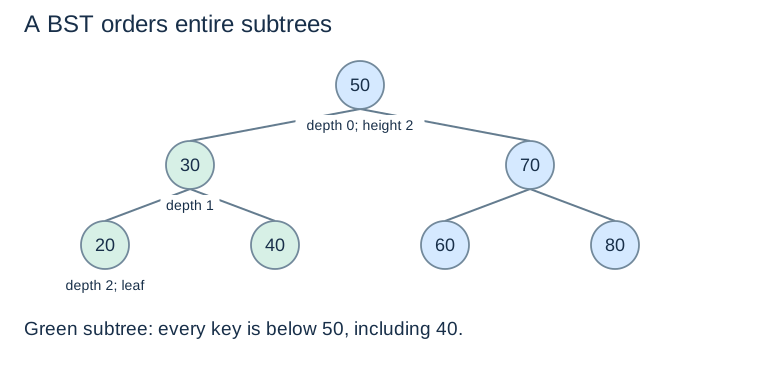
A BST orders every descendant
For distinct keys, a binary search tree (BST) requires, at every node:
every key in its left subtree is smaller than its key;
every key in its right subtree is larger;
both child subtrees obey the same rule.
The reference tree comes from inserting 50, 30, 70, 20, 40, 60, 80. Key 40 is larger than 30 but smaller than 50; both constraints matter.
Bounds accumulate along the path
Going left of 50 establishes an upper bound of 50. Going right of 30 then establishes a lower bound of 30. Every descendant in that region must stay strictly between 30 and 50.
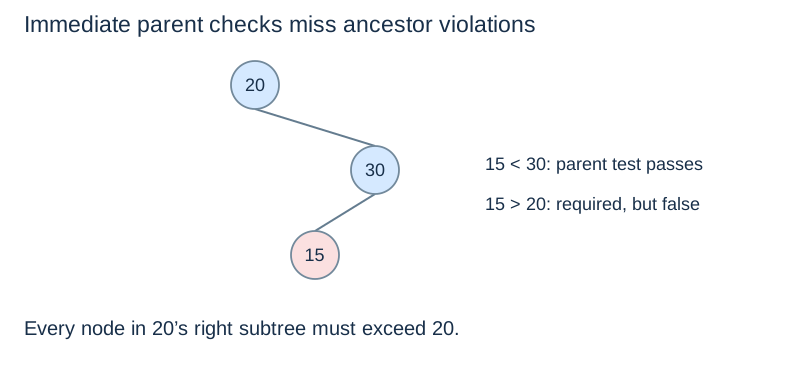
In the invalid example, 15 < 30 is locally plausible, but the node is in 20’s right subtree and must also exceed 20. Checking only immediate parent–child comparisons misses the violation. A validator should pass lower and upper bounds down recursively.
Declare what equal keys mean
This chapter stores one node per key: inserting an existing key is a no-op. A map can instead replace its associated value; a multiset can store an occurrence count. Whichever policy is chosen, insertion, lookup, traversal and deletion must agree.
Representation choices and use
These nodes represent an ordered set, not a key–value map or a frequency-preserving multiset. The common operation contract makes those distinctions concrete. The logical tree uses O(n+1) node storage; child links alone provide neither a cached size nor constant-time height. Searching uses the ordering, while AVL adds height metadata in Topic 8.
Moving equal keys arbitrarily between subtrees changes the invariant and can invalidate search assumptions. Our strict left/right inequalities keep the core reasoning clear.
Check your understanding
Predict the returned result, links or invariant before opening the explanation.
1. Why is 15 invalid below 30 in the right subtree of 20, despite 15<30?
Show explanation
The earlier right turn also requires 15>20. Its immediate parent comparison alone misses that bound.
2. Does a binary tree automatically have logarithmic height?
Show explanation
No. Binary only limits child positions to two; a chain is still binary.
Next: BST lookup and insertion.