After this page, you should be able to:
Trace all three visit orders and explain why inorder is sorted for a BST.
Find extremes and strict neighbours with explicit missing-result behaviour.
Builds on: BST nodes and lookup establish the representation.
Code languages: Python defines the explanations, figures and self-checks. Use the language guide for native conventions and dependencies. Complete runnable topic examples: Python · JavaScript · Julia.
Python and JavaScript positions are zero-based; Julia vector positions and insertion boundaries are one-based. A missing lookup is None/null/nothing, while a boundary query can return the one-past-end position. Julia public ordered-set operations use functions such as add!, ordered_keys and range_keys.
Operation contracts and invariant
All traversals return a new list of key references and leave links unchanged; empty trees give []. All assume a finite acyclic tree. Inorder is sorted only under the strict BST invariant. Extreme/strict-neighbour helpers return a node, or None if no such node exists, without mutation.
One tree, several visiting orders
Traversal visits every node rather than looking for one key. The names below locate the current node relative to its recursive child visits:
| Traversal | Visit order | Reference-tree output |
|---|---|---|
| Preorder | node, left, right | 50, 30, 20, 40, 70, 60, 80 |
| Inorder | left, node, right | 20, 30, 40, 50, 60, 70, 80 |
| Postorder | left, right, node | 20, 40, 30, 60, 80, 70, 50 |
These outputs refer to the seven-node reference tree before inserting 65. Preorder visits a parent before its descendants; postorder visits it after them. The tree’s links stay unchanged.
Inorder exposes the BST’s sorted order
def inorder_keys(root):
    result = []

    def visit(node):
        if node is None:
            return
        visit(node.left)
        result.append(node.key)
        visit(node.right)

    visit(root)
    return result
function inorder_keys(root) {
const out = [];
function visit(node) {
if (node === null) return;
visit(node.left);
out.push(node.key);
visit(node.right);
}
visit(root); return out;
}function inorder_keys(root)
out = Any[]
function visit(node)
node === nothing && return
visit(node.left)
push!(out, node.key)
visit(node.right)
end
visit(root); return out
endWhy sorted? Recursively sorted left keys are all smaller than the node; recursively sorted right keys are all larger. Concatenating them in left–node–right order preserves ascending order. This conclusion uses the BST invariant: inorder on an arbitrary binary tree need not be sorted.
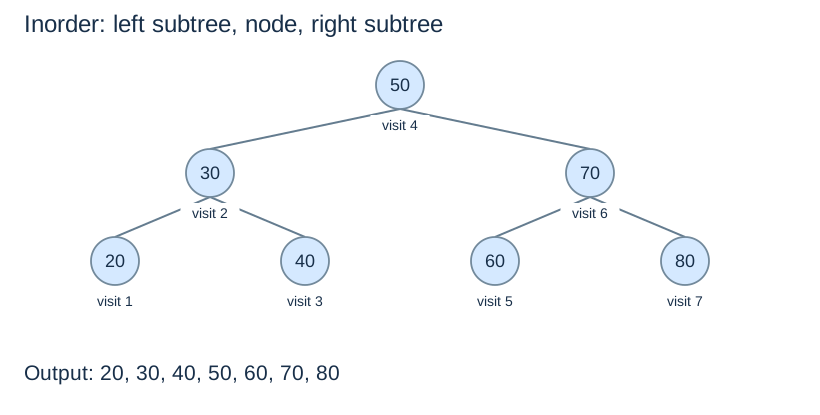
The helper performs constant local work per node, so time is . Its returned list occupies output space; the recursion needs additional stack space. Avoid repeatedly concatenating subtree lists if you intend this linear-time analysis.
Preorder and postorder implementations
def preorder_keys(root):
    out = []
    def visit(node):
        if node is not None:
            out.append(node.key)
            visit(node.left)
            visit(node.right)
    visit(root)
    return out

def postorder_keys(root):
    out = []
    def visit(node):
        if node is not None:
            visit(node.left)
            visit(node.right)
            out.append(node.key)
    visit(root)
    return out
function preorder_keys(root) {
const out = [];
function visit(node) {
if (node === null) return;
out.push(node.key);
visit(node.left);
visit(node.right);
}
visit(root); return out;
}
function postorder_keys(root) {
const out = [];
function visit(node) {
if (node === null) return;
visit(node.left);
visit(node.right);
out.push(node.key);
}
visit(root); return out;
}function preorder_keys(root)
out = Any[]
function visit(node)
node === nothing && return
push!(out, node.key)
visit(node.left)
visit(node.right)
end
visit(root); return out
end
function postorder_keys(root)
out = Any[]
function visit(node)
node === nothing && return
visit(node.left)
visit(node.right)
push!(out, node.key)
end
visit(root); return out
endEach node is visited once, in the declared order. All three listings append into one output list rather than repeatedly concatenate subtree results: O(n+1) time, O(h+1) stack and O(n) output. Recursion follows the links, so a deep ordinary BST can encounter Python’s recursion-depth limit; AVL bounds the abstract depth but does not change the traversal’s linear output cost.
Extreme keys are at opposite edges
def bst_minimum(node):
    if node is None:
        return None
    while node.left is not None:
        node = node.left
    return node
function bst_minimum(node) {
if (node === null) return null;
while (node.left !== null) node = node.left;
return node;
}function bst_minimum(node)
node === nothing && return nothing
while node.left !== nothing; node = node.left; end
return node
endFollow left links to find the minimum; follow right links for the maximum. The result is a node, or None for an empty tree. Each operation takes time and constant iterative auxiliary space.
The successor is the next larger key
If a node has a right subtree, its inorder successor is that subtree’s minimum. It may be the immediate right child or a deeper descendant. If there is no right subtree, the successor is the lowest ancestor for which the node lies in its left subtree; finding it requires parent information or a search from the root. The largest key has no successor.
For node 50, the reference successor is 60. Adding a right child 65 to 60 does not change that fact. The successor’s own left child must be empty, but its right child need not be. This is crucial for two-child deletion.
Maximum and strict-neighbour implementations
def bst_maximum(node):
    if node is None:
        return None
    while node.right is not None:
        node = node.right
    return node

def bst_successor(root, key):
    candidate = None
    node = root
    while node is not None:
        if key < node.key:
            candidate = node
            node = node.left
        else:
            node = node.right
    return candidate

def bst_predecessor(root, key):
    candidate = None
    node = root
    while node is not None:
        if node.key < key:
            candidate = node
            node = node.right
        else:
            node = node.left
    return candidate
function bst_maximum(node) {
if (node === null) return null;
while (node.right !== null) node = node.right;
return node;
}
function bst_successor(root, key) {
let candidate = null, node = root;
while (node !== null) {
if (key < node.key) { candidate = node; node = node.left; }
else node = node.right;
}
return candidate;
}
function bst_predecessor(root, key) {
let candidate = null, node = root;
while (node !== null) {
if (node.key < key) { candidate = node; node = node.right; }
else node = node.left;
}
return candidate;
}function bst_maximum(node)
node === nothing && return nothing
while node.right !== nothing; node = node.right; end
return node
end
function bst_successor(root, key)
candidate = nothing; node = root
while node !== nothing
if key < node.key; candidate = node; node = node.left
else; node = node.right; end
end
return candidate
end
function bst_predecessor(root, key)
candidate = nothing; node = root
while node !== nothing
if node.key < key; candidate = node; node = node.right
else; node = node.left; end
end
return candidate
endFor successor, a key greater than the query is a candidate; only its left subtree can improve it. A key at most the query excludes its entire left side. Predecessor mirrors that reasoning. Retaining a candidate replaces the need for parent pointers. Equality is deliberately excluded: the successor/predecessor is strictly greater/smaller, even when the query is stored.
Each helper follows one path: O(h+1) time and O(1) workspace. Empty trees and queries beyond the relevant extreme return None. On the seven-node reference tree, successor(55) is node 60; predecessor(50) is node 40; successor(80) is None. These queries do not require the query key to be present. The public adapter converts a missing-node result to a stated exception.
Implementation choices and suitability
Preorder places a parent before children; postorder places it after them; neither promises sorted output. Inorder, extremes and neighbours suit ordered keys. Adding parent pointers or cached extremes can change particular operation costs, but also adds update invariants. None is assumed here.
Check your understanding
Predict the returned result, links or invariant before opening the explanation.
1. Before inserting 65, what is the successor of 50? Does adding 65 change it?
Show explanation
It is 60 in both trees. Adding a larger right child to 60 does not change the smallest key greater than 50.
2. Does preorder on a BST necessarily return sorted keys?
Show explanation
No. Inorder follows left-node-right and is sorted under the BST invariant; preorder follows a different visiting order.
Next: Closed-range queries.