After this page, you should be able to:
Trace inclusive candidate bounds for success, failure and empty input.
Distinguish an index result and a probe bound from sorted-data preparation.
Builds on: Sorting contracts supply the ordered-input precondition.
Code languages: Python defines the explanations, figures and self-checks. Use the language guide for native conventions and dependencies. Complete runnable topic examples: Python · JavaScript · Julia.
Python and JavaScript positions are zero-based; Julia vector positions and insertion boundaries are one-based. A missing lookup is None/null/nothing, while a boundary query can return the one-past-end position. Julia public ordered-set operations use functions such as add!, ordered_keys and range_keys.
What can a comparison exclude?
Linear search checks candidates one at a time and needs no sorted-input precondition. On an arbitrary unsorted list, seeing one unequal value does not tell us which other values can be skipped. An unsuccessful scan of items takes comparisons.
Sorted order lets us discard a whole side
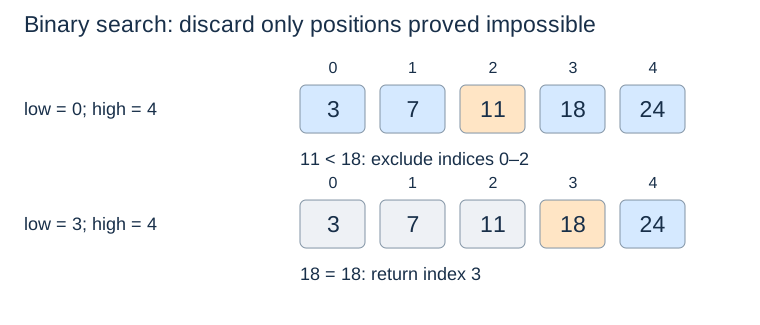
For an ascending sequence, if a[mid] < target, every position at or before mid also has a value below the target. If the middle value is too large, every position at or after it is too large. This implication depends on the sequence being sorted under the same comparison rule used by the search.
Operation contract and implementation choices
binary_search(a,target) observes an ascending, random-access sequence and returns one matching index or None. It never changes the sequence. An empty input returns None; duplicates do not imply a first-match guarantee. Input and query comparisons must follow the same consistent ordering.
This implementation uses inclusive endpoints, integer midpoint calculation and index bounds instead of slices. Its workspace is constant; a recursive or slicing version needs a separate space/copy analysis. The trace above uses the same sorted input as the code’s correctness argument.
Keep an inclusive interval
The invariant is: if the target occurs, at least one matching position remains in low..high. Here both endpoints are inclusive. Initially this is the entire sequence; it becomes empty when low > high.
Python is the teaching and diagram language throughout this page. Choose JavaScript or Julia to read the same inclusive-interval algorithm. These are code listings to copy and run; selecting a tab changes the display.
def binary_search(a, target):
    low, high = 0, len(a) - 1
    while low <= high:
        mid = (low + high) // 2
        if a[mid] == target:
            return mid
        if target < a[mid]:
            high = mid - 1
        else:
            low = mid + 1
    return None
function binary_search(a, target) {
let low = 0, high = a.length - 1;
while (low <= high) {
const mid = low + Math.floor((high - low) / 2);
if (a[mid] === target) {
return mid;
}
if (target < a[mid]) {
high = mid - 1;
} else {
low = mid + 1;
}
}
return null;
}function binary_search(a, target)
low, high = 1, length(a)
while low <= high
mid = low + div(high - low, 2)
if a[mid] == target
return mid
end
if target < a[mid]
high = mid - 1
else
low = mid + 1
end
end
return nothing
endThe result is an index, not the target value. In Python, test absence with result is None; index zero is a valid success even though it is false in a Boolean context. The language-specific absence values and indices are compared below. Empty and singleton inputs use the same algorithm.
Each mismatch excludes mid itself, so high = mid - 1 or low = mid + 1 strictly reduces the interval. Using low = mid can stall when only two candidates remain. An interval convention such as [low, high) also works, but its initialisation, loop condition and updates must be consistent with that convention.
Run the same example in each language
Run the selected definition above before its matching example below. The implementation and example tabs switch language together. Python is the initial selection on this page.
values = [3, 7, 11, 18, 24]
print(binary_search(values, 18))  # 3
print(binary_search(values, 3))   # 0
print(binary_search(values, 20))  # None
print(binary_search([], 18))      # None
const values = [3, 7, 11, 18, 24];
console.log(binary_search(values, 18)); // 3
console.log(binary_search(values, 3)); // 0
console.log(binary_search(values, 20)); // null
console.log(binary_search([], 18)); // nullvalues = [3, 7, 11, 18, 24]
println(binary_search(values, 18)) # 4
println(binary_search(values, 3)) # 1
println(binary_search(values, 20)) # nothing
println(binary_search(Int[], 18)) # nothing| Convention | Python | JavaScript | Julia |
|---|---|---|---|
| Container in these examples | List | Array | Ordinary one-based Vector |
| First valid index | 0 | 0 | 1 |
| No matching value | None | null | nothing |
| Explicit absence test | result is None | result === null | result === nothing |
| Index of 18 in the example | 3 | 3 | 4 |
Index returned for [2, 2, 2], target 2 | 1 | 1 | 2 |
Julia’s answer 4 means the same fourth element as index 3 in Python and JavaScript. Read the diagram and existing self-check indices as Python indices. To translate a successful position from this Julia vector to a zero-based trace, subtract one; leave absence as absence.
All three versions observe the input, keep an inclusive candidate interval, discard the midpoint after a mismatch and return one match without a first-match guarantee. JavaScript and Julia compute the midpoint as low + half the remaining distance; it selects the same relative position as Python’s formula. Math.floor and div supply an integer half here; JavaScript bitwise midpoint tricks would impose a 32-bit conversion and are avoided.
For the parallel examples, use ascending numeric arrays/vectors whose values have the same ordering and equality in all three languages. Integer examples stay within JavaScript’s safe-integer range. The Julia listing assumes an ordinary one-based vector; offset-indexed arrays, strings and custom indexing are outside this example. None of these listings validates sortedness or repairs invalid comparison data such as NaN. The original Python contract can also apply to other consistently ordered random-access values.
To read code without switching tabs, open the complete runnable examples directly: Python, JavaScript and Julia. Run them with python binary_search.py, node binary_search.js or julia binary_search.jl, respectively.
Language references: Julia’s differences from Python and JavaScript safe integers.
Explain the result and termination
Initialisation includes every possible match. A mismatch preserves the invariant by discarding only values proved too small or too large. The nonnegative number of candidates strictly decreases. Equality returns a valid match; an empty interval combined with the invariant establishes absence.
For example, searching for 20 in [3, 7, 11, 18, 24] inspects 11, 18 and 24, then ends with low = 4, high = 3. Failure is a justified result, not an exceptional case.
Repeated values and boundary queries
This function returns some matching position. In [2, 2, 2], it can return index 1; it does not promise the first occurrence. Finding the first value at least a target is a different contract, often called a lower-bound query. Finding one match does not by itself establish either edge of a duplicate run.
Halving counts probes, not all preparation
With constant-time indexing and comparisons, the worst-case probe count is and iterative auxiliary space is . A recursive implementation using index bounds instead has call-stack space in the worst case. Slicing copies data and changes the cost analysis.
For empty input the cost is constant; a uniform bound is O(log(n+2)). No result list is allocated. This is a useful choice for mostly static sorted arrays; linked-list indexing does not satisfy the constant-time-access assumption.
Sorting an unsorted collection before a single query is additional work. Repeated queries may justify maintaining sorted data; binary search itself does not make insertions into a sorted array cheap.
Check your understanding
Predict the returned result, links or invariant before opening the explanation.
1. What does exact search return on []? What about a match at the first position?
Show explanation
An empty sequence returns None; a first-position match returns 0, which is a valid index.
2. Does low=mid always make progress after a mismatch?
Show explanation
No. On two candidates, mid can equal low. The inclusive algorithm uses mid+1 to exclude the disproved midpoint.
Next: Search boundaries.