After this page, you should be able to:
Compare representation costs under explicit height and input assumptions.
Separate construction, update paths, workspace and output costs.
Builds on: The common ordered-set interface connects the implemented operations.
Height determines the longest search path
A BST with nodes can have height as small as or as large as . Inserting distinct ascending keys into an ordinary BST creates a right-leaning chain. The ordering invariant still holds, but each comparison may eliminate almost nothing.
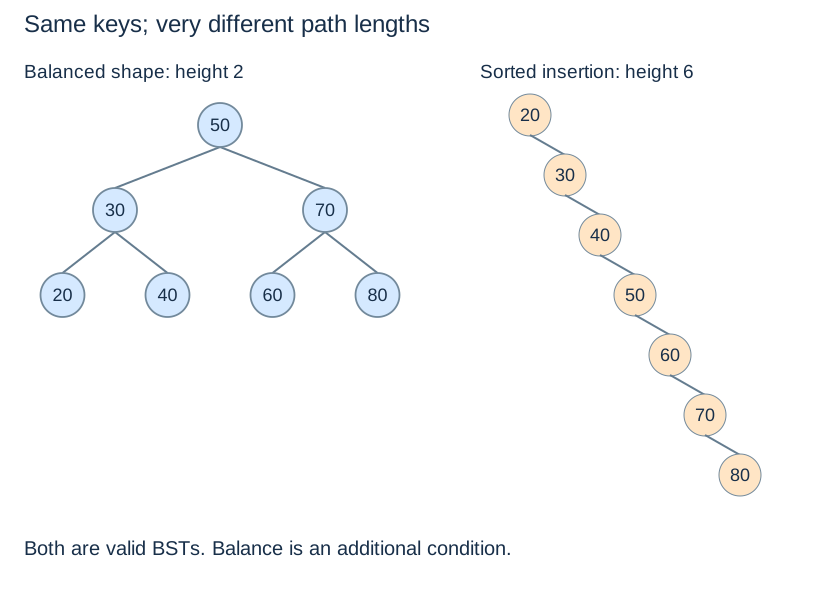
Search, insertion, deletion, minimum and maximum take time. They are logarithmic only when height is logarithmic. One lucky root match remains constant-time even in a tall tree; worst-case costs describe the longest relevant path.
Choose for queries and updates together
| Representation | Exact search | Ordered output | Updating the collection |
|---|---|---|---|
| Unsorted array | scan | Sort first | Back append can be amortised |
| Sorted array | binary search | Sequential scan | Ordered insertion/removal can shift items |
| Ordinary BST | inorder | search and local edit | |
| AVL tree | inorder | with maintained balance | |
| Hash table | Expected under suitable assumptions | No key-sorted order supplied | Expected/amortised bounds depend on hashing and resizing |
The bounds assume constant-time key comparisons and the representations already exist. Building, sorting or hashing the input is additional work. Hash-table expected time is not a worst-case constant-time promise; see Topic 6.
Time and space by operation
See the shared ordered-set cost table for exact lookup, updates, neighbours, extraction, snapshots, ranges and cached size. Persistent tree storage is O(n+1); raw node helpers do not cache a global count. Iterative single-path readers use O(1) workspace; recursive updates and traversal use O(h+1), plus any output list. AVL makes that path logarithmic but does not remove output costs.
Implementation choices matter: array access is direct, sorted-array updates shift records, raw BST height depends on input order, and AVL pays to maintain balance. Repeated AVL insertion builds n keys in O(n log(n+2)) time. Static middle-key construction assumes already sorted distinct input and is conceptual here; neither code path includes sorting for free.
A cheap operation bound does not build the structure for free
Inserting ascending keys into an unbalanced BST can cost . A balanced structure avoids the growing chain, but still needs to perform the insertions. If sorted distinct keys are already available, a static BST can instead be constructed by recursively choosing middle keys, producing logarithmic height in linear node-construction time with index ranges.
Tree shape, storage and workload are separate considerations. A sorted array can be excellent for a mostly static dataset with frequent queries. A balanced BST is useful when ordered data changes repeatedly. A linked representation does not automatically make every update constant-time: locating the correct place remains part of the operation.
Check your understanding
Predict the returned result, links or invariant before opening the explanation.
1. How much total work can ascending repeated insertions take in an ordinary BST?
Show explanation
Quadratic: the growing chain makes successive paths proportional to 1,2,…,n−1.
2. Can a balanced tree report all n keys in logarithmic time?
Show explanation
No. The output has n keys, so reporting alone requires linear work.
Continue to Topic 8: balanced search trees, or return to the concept index.